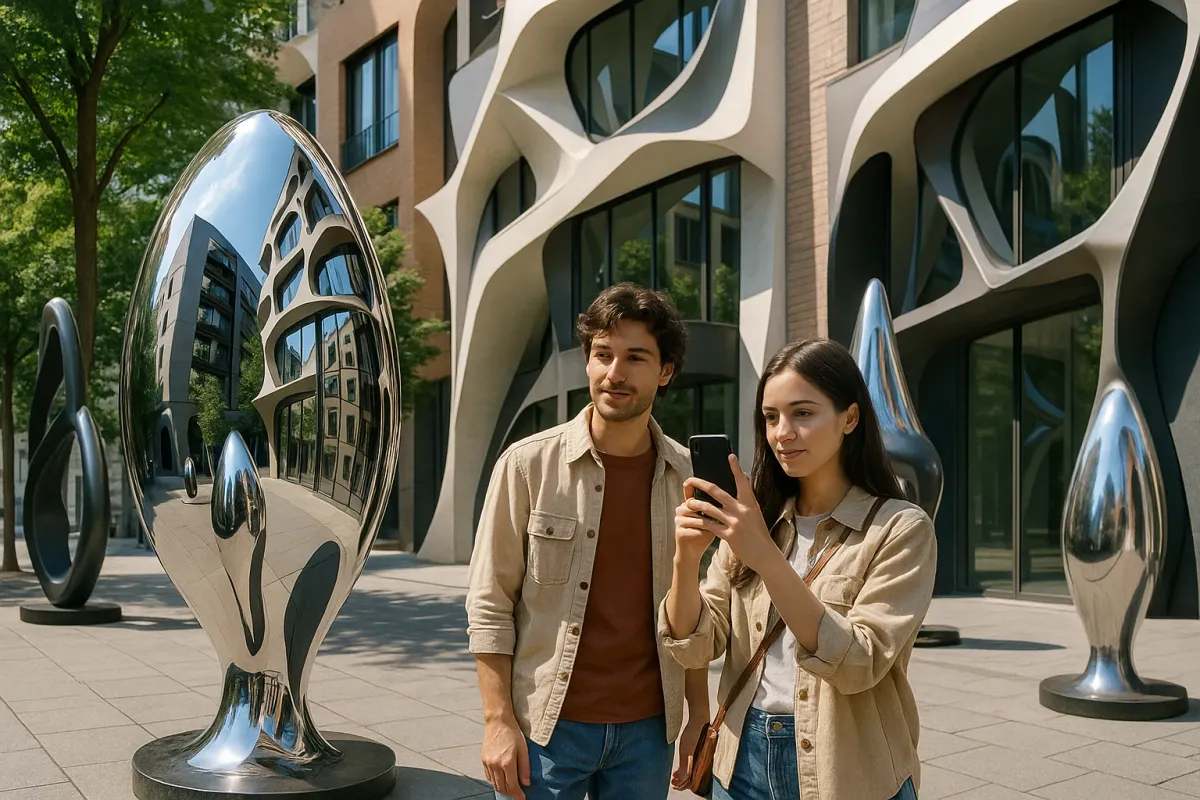
There is a quiet revolution happening in the world’s most photographed streets and plazas. From the gravity-defying “Floating” figures in London to Anish Kapoor’s mirrored icons in Chicago and Mumbai, contemporary outdoor sculpture is no longer just public art—it is a global mood board for how we want spaces to feel: immersive, magnetic, and unforgettable. A recent feature showcasing “50 sculptures around the world so unbelievable they’ll leave you wondering how they even exist” has gone viral, and it’s no coincidence. As cities turn boulevards into open-air galleries, discerning homeowners are asking a sharper question: What would it look like to bring that same sense of wonder home?
At Renovate Quotient, we see this cultural moment as more than visual entertainment. These sculptural interventions—by names like Olafur Eliasson, Jaume Plensa, and Tomas Saraceno—are setting the design language for high-end residential projects in 2026 and beyond. The new luxury is not more stuff; it’s spaces that feel curated, cinematic, and artful from the minute you open the door. Below, we translate this global public-art phenomenon into five strategic, design-forward insights for homeowners planning sophisticated renovations right now.
1. Sculptural Silhouettes Are Replacing Flat Minimalism
Look at today’s most shared public sculptures—from the cloud-like forms of Kapoor’s “Cloud Gate” to the impossible balance of street installations in Dubai and Singapore—and a clear theme emerges: silhouette is everything. These pieces are instantly recognizable not because they are loud, but because they are memorable in profile.
High-end residential design is absorbing that lesson. The age of only “clean, flat, minimal lines” is quietly evolving into a more dimensional minimalism—one where a staircase, kitchen island, or fireplace becomes the sculptural anchor of the home. Instead of adding more décor, designers are shaping the architecture itself as the art.
For homeowners planning a renovation, this means prioritizing forms that are striking from multiple viewpoints. Think of:
- A staircase with a ribbon-like handrail that reads as sculpture from the entry.
- A kitchen island with a monolithic stone volume and a single, cantilevered overhang.
- A fireplace that steps, folds, or curves rather than simply framing an opening.
The design conversation with your architect or interior designer should include the question: What is the home’s defining silhouette when seen from the main axis? The result is a space that feels deliberately composed—more gallery than showroom—without a single extra object on the floor.
2. Immersive Light Is Becoming the New Luxury Material
Many of the world’s most compelling outdoor works—such as Olafur Eliasson’s light-based installations or the illuminated sculptures now defining skyline photos in cities like Seoul and Dubai—are less about the object and more about the experience of light. They look different at dawn, noon, and midnight. They invite you to move around them.
In refined residential design, light is stepping into that same starring role. The next wave of premium homes will be defined not only by surfaces, but by how those surfaces choreograph light throughout the day and night. Instead of simply upgrading fixtures, sophisticated renovations are:
- Using recessed, hidden, and grazing light to carve out sculptural shadows on textured walls.
- Pairing large-format glazing with deeply modeled façades that create dynamic light patterns indoors.
- Integrating programmable lighting scenes that transform the home from gallery-bright to restaurant-intimate at a touch.
Treat light as you would marble: a material that deserves strategy, not just specification. In early planning, request a lighting concept narrative alongside your floor plans—a document that explains how light will dramatize volumes, accent art, and highlight architectural details. Done well, your home will echo the quiet theatricality of world-class outdoor installations, without ever feeling stagey.
3. Outdoor Rooms Are Being Curated Like Urban Plazas
The global fascination with extraordinary outdoor sculptures—whether installed in European squares, coastal promenades, or rooftop terraces in cities like New York and Hong Kong—underscores a broader shift: people are craving compelling open-air experiences, not just views.
High-end residential projects are following suit by treating terraces, courtyards, and gardens less like leftover space and more like private plazas. The most forward-thinking homeowners are structuring their outdoor environments with the same intentionality that cities bring to public art:
- A focal form: this could be a water feature, a custom stone bench, or a single sculptural tree in a corten-steel planter.
- Defined sightlines: paths, plantings, and exterior walls that frame a “hero view” when you look out from key rooms.
- Layered seating: built-in benches, lounge groupings, and dining zones arranged as if curating an outdoor salon.
Crucially, the goal is not to replicate a hotel but to create a restrained, highly personal outdoor composition. Consider a single commissioned piece—perhaps from a local ceramicist or metal artist—as your courtyard’s equivalent of a plaza sculpture. When your outdoor spaces are this intentional, the boundary between architecture, landscape, and art dissolves, and your home feels as thoughtfully orchestrated as a beloved city square.
4. Reflective and Living Surfaces Are Redefining “Finished”
Many of today’s most photographed sculptures—from mirrored orbs that reflect entire skylines to installations that incorporate water, plants, or even fog—are not static. They shift with weather, season, and time of day. This idea of a surface that participates in its environment is now quietly shaping luxury residential finishes.
In sophisticated renovations, we’re seeing a move away from purely matte or polished surfaces toward materials that capture and refract the world around them:
- Softly reflective stone and glazed tile that pick up changing daylight tonalities.
- Patinated metals—bronze, brass, zinc—that evolve gracefully rather than trying to stay perfect.
- Integrated green walls and planted courtyards that blur the distinction between “inside finish” and “outside life.”
For homeowners, the strategic question becomes: Where could a reflective or living surface introduce movement without chaos? Perhaps it is a mirrored niche that doubles the perceived volume of a hallway, or a bronze-clad column that warms and deepens over time. Instead of chasing trends in colors and patterns, you are investing in materials that stage a subtle, daily performance. The home feels less like a static object and more like a living, responsive environment—much like the best public sculptures that look different every time you pass by.
5. Narrative-Driven Spaces Are the New Status Symbol
The viral interest in extraordinary sculptures worldwide has a deeper undertone: people are not just sharing images; they’re sharing stories—who designed the piece, why it exists in that city, what it symbolizes. The most sought-after public works carry a narrative that locals can explain with a sense of pride.
Translated into residential design, narrative is becoming a powerful form of luxury. A home feels truly elevated when every major design move can answer, “Why is it like this?” with something more interesting than “We saw it on Pinterest.” The most refined renovations now build a quiet story into their spaces:
- A staircase that references a favorite gallery or museum experience.
- Stone selections that trace back to a specific quarry, with visible veining treated like abstract art.
- A library or salon organized around a personal collection—photography, sculpture, or artisanal objects—displayed with museum-grade restraint.
When planning your project, ask your design team to articulate a conceptual through-line, the way an artist would explain a body of work. This could be “light and shadow,” “geometric calm,” or “urban courtyard.” Every key decision—materials, proportions, joinery details—should reinforce that narrative. The outcome is a home that feels less like an assemblage of expensive things and more like a coherent, deeply personal composition, worthy of being walked through the way one might move through a thoughtfully curated outdoor sculpture park.
Conclusion
As cities worldwide turn their public spaces into open-air galleries, they are inadvertently sketching the blueprint for the next era of residential design. Sculptural silhouettes, immersive light, curated outdoor rooms, responsive surfaces, and narrative-rich spaces are no longer the domain of museums and plazas; they are becoming the defining traits of the most sophisticated homes.
For homeowners renovating now, the opportunity is clear: look beyond fleeting décor trends and study how the world’s most compelling sculptures command attention, frame views, and orchestrate emotion. Then, with the right design team, translate those principles into architecture that does not merely shelter—but captivates. In a world saturated with images, the true luxury is a home that feels as unforgettable as the places people travel across continents to photograph.
Key Takeaway
The most important thing to remember from this article is that this information can change how you think about Design Trends.