The internet’s current fascination with jaw‑dropping public sculptures—like those highlighted in Bored Panda’s trending feature on “50 Sculptures Around The World So Unbelievable They’ll Leave You Wondering How They Even Exist”—isn’t just a cultural moment. It’s a design briefing for anyone planning a serious home renovation in 2025–2026.
From Anish Kapoor’s mirrored “Cloud Gate” in Chicago to Jaume Plensa’s ethereal figures and Olafur Eliasson’s experiential installations, the world’s most photographed sculptures are quietly rewriting how we think about scale, light, material, and the emotional impact of a space. The same principles that drive people to share these pieces millions of times on social media can be translated into a private residence—particularly its exterior and outdoor living areas.
Below are five refined, renovation‑ready insights drawn from the global sculpture boom—distilled for homeowners who expect their projects to feel as considered and enduring as a piece in a world‑class museum.
1. Design the Arrival Like a Gallery, Not a Driveway
The most shared sculptures today—from Antony Gormley’s monumental figures to immersive street‑level installations in cities like Madrid and Seoul—understand one thing: arrival is a experience, not a direction of travel. In a high‑end renovation, your driveway, front walk, and entry sequence should be treated as a curated procession, not leftover space for paving and plants.
Begin with a clear narrative: what do you want a guest to feel in the first 15 seconds? Calm understatement, dramatic tension, or a quiet reveal? That emotion should dictate everything from the geometry of the path to the height of planting and the placement of lighting.
Borrow a page from sculpture parks that build anticipation with layers: a long, subtly curved approach; a framed view of a significant element (a specimen tree, a water feature, a sculptural bench) that doesn’t fully reveal itself until the last moment; and a controlled palette of materials underfoot so visual noise remains low.
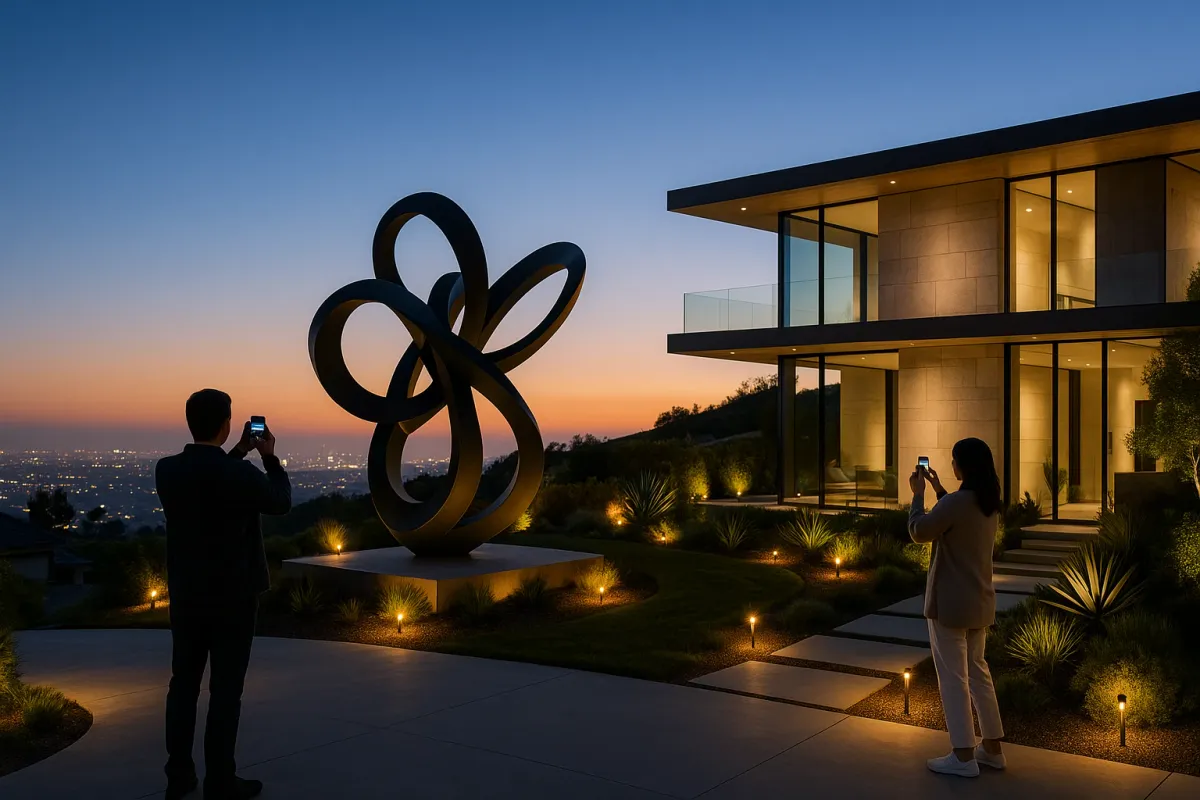
Instead of scattering décor, invest in one or two “anchor” elements—perhaps a custom corten steel screen, a carved stone plinth, or a minimalist reflective pool—that read as art rather than ornament. The goal is not opulence, but a sense of intention: nothing feels accidental, and nothing competes for attention.
Technically, this may mean re‑grading the approach, rethinking garage placement, or upgrading to in‑ground, low‑glare lighting systems that wash surfaces rather than spotlight them. These are structural moves that belong on the renovation drawings from day one, not after the slab is poured and compromises become expensive.
2. Use Sculptural Forms to Control Light, Shadow, and Privacy
The most compelling sculptures in the viral Bored Panda compilation are not simply objects; they are instruments for light. Think of Eliasson’s work with refracted sunlight or Tomás Saraceno’s web‑like installations casting intricate shadows. For a sophisticated renovation, exterior forms should be designed to choreograph light and privacy in the same way.
Instead of defaulting to flat fences and standard pergolas, explore three‑dimensional elements that modify the atmosphere throughout the day: slatted timber volumes that filter morning sun; perforated metal panels that cast patterned shadows on terraces; deep reveals around glazing that create pockets of shade and a sense of thickness in the façade.
A high‑end approach treats these elements as permanent architecture, not bolt‑on décor. For instance, a sculpted masonry wall that folds, curves, or steps can both screen a neighboring property and create niches for seating or planting. A stair to a rooftop terrace can become a carved “sculptural spine” with integrated lighting, rather than a utilitarian escape route.
The crucial detail: involve your architect and structural engineer early to ensure these sculptural moves are integral to the building envelope. That allows you to integrate insulation, drainage, and fixings invisibly, preserving clean lines. On social media, it’s the crisp junctions and elegantly resolved corners that distinguish a premium project from a visually similar but value‑engineered one.
3. Invest in Fewer, Better Materials—Curated Like a Museum Program
Global sculptures that dominate our feeds rarely rely on excessive variety. Instead, they exhibit discipline: one or two primary materials, deployed with conviction and refined detailing. This is the lesson many luxury home renovations ignore in favor of trend stacking—three kinds of cladding, four metals, and a patchwork of paving that quickly dates.
Take a cue from iconic pieces: Kapoor’s seamless stainless steel, Richard Serra’s monumental weathering steel, or Isamu Noguchi’s stone. For a premium renovation, choose a limited, deeply considered materials palette for your exterior and outdoor rooms—then allocate budget to the best possible version of those materials and their craftsmanship.
For example, instead of mixing five types of hardscape, commit to one primary stone, perhaps complemented by a single contrast material for steps or thresholds. If you’re drawn to metal, decide early whether your project is a brass/bronze story, a blackened steel story, or a warm aluminum story—then align window frames, handrails, light fixtures, and hardware accordingly.
This level of curation requires coordination between architect, interior designer, landscape designer, and builder—ideally anchored by a shared “materials board” that is treated as non‑negotiable unless a conscious design shift occurs. The pay‑off is visual calm, longevity, and a home that photographs as cohesively as a sculpture garden in Barcelona or Copenhagen. In a resale context, disciplined materiality reads as “architect‑designed” and commands a premium without shouting.
4. Make Outdoor Spaces Experiential, Not Merely Beautiful
The outdoor sculptures now circulating online are popular not just because they look extraordinary, but because they invite interaction: you walk under them, touch their surfaces, hear water, or experience a framed view. Luxury home renovations often stop at visual composition—beautiful terraces, lush planting—but neglect the sensory choreography that turns space into memory.
Borrow from experiential art when planning outdoor living: design for sequence, touch, and sound. Imagine entering a courtyard where the crunch of gravel subtly shifts to smooth stone; where a narrow passage suddenly opens to a generous, sky‑framed patio; where a restrained water feature provides a low, steady acoustic backdrop that masks neighboring streets.
Consider micro‑destinations: a breakfast terrace oriented to the morning sun; a dusk‑oriented fire pit zone with low seating; a quiet bench beneath a single, perfectly lit tree. These are akin to “rooms in a museum”—each with a different emotional register, but linked by consistent material and detailing.
You’ll likely need to plan for infrastructure earlier than expected: gas lines to remote fire features, drainage for reflective water elements, concealed power for art lighting or integrated speakers. In premium projects, these are built into the slab and landscape base, not surface‑mounted as an afterthought. The more invisible the infrastructure, the more effortlessly “sculptural” and serene the experience feels.
5. Commission or Curate One Signature Piece that Anchors the Entire Renovation
The international appetite for distinctive public art—seen in city‑backed installations from New York’s High Line to Singapore’s Marina Bay—demonstrates a growing understanding: a single, well‑chosen piece can brand an entire environment. At home, the same logic applies. A thoughtfully placed signature piece can anchor your renovation concept, guide design decisions, and create instant recognizability in an increasingly homogeneous luxury market.
This doesn’t require a blue‑chip artist, but it does require intention. Early in the renovation, identify a location that can carry a focal piece: perhaps the end of a long axis view from the entry, the center of a courtyard, or the far edge of a pool. Then decide whether that anchor will be an artwork you commission, a bespoke architectural element (a sculpted concrete stair, a monolithic fireplace, a custom bronze gate), or a living piece such as a specimen tree framed and lit as sculpture.
Engage an art consultant if your budget and ambitions justify it; they can help align the piece with your taste, the home’s architecture, and long‑term value. Even at a more modest level, collaborating with a local sculptor or artisan can produce a one‑off element—hand‑cast planters, carved stone water basins, or a custom metal screen—that no neighboring property can replicate.
Once chosen, allow this anchor to influence proportion, palette, and lighting throughout the project. Much like a museum builds a show around a major work, your renovation can derive coherence from a single, clearly defined focal point. In images and video (which is how most people will first experience your home), this is the moment everyone remembers—and shares.
Conclusion
The viral celebration of extraordinary sculptures around the world is more than a visual escape; it’s a design handbook for homeowners willing to think beyond square footage and surface finishes. By treating your renovation as a curated, sculptural experience—prioritizing arrival, light, material discipline, sensory engagement, and one defining focal point—you elevate your home from “well updated” to quietly iconic.
In a landscape where luxury listings often look indistinguishable in a scroll, the residences that will endure are those that borrow from the rigor of public art: fewer gestures, perfectly executed, with an unwavering respect for how people actually feel as they move through space. That is the true renovate quotient—measured not only in resale value, but in the daily pleasure of living inside a composition as considered as anything in a sculpture park.
Key Takeaway
The most important thing to remember from this article is that this information can change how you think about Home Renovation.