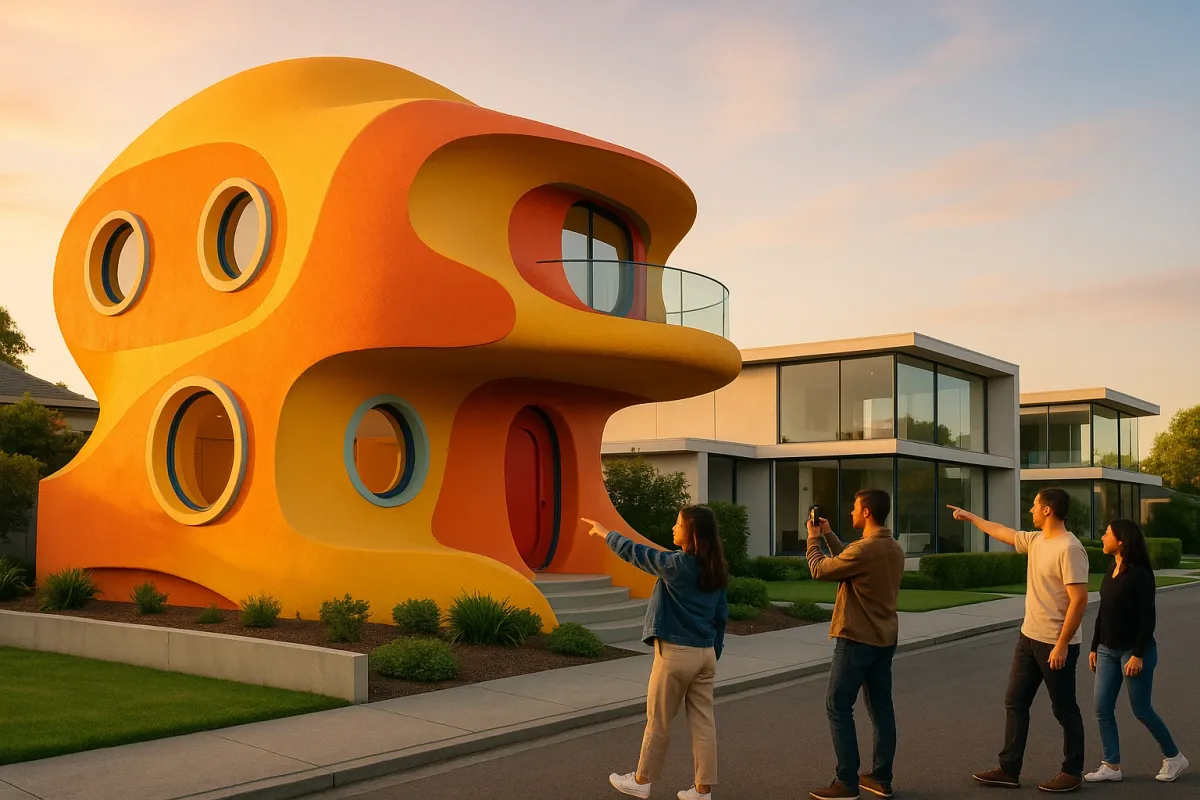
There is a building in Niigata, Japan, shaped exactly like a loaf of bread. Another, in Sopot, Poland, folds and ripples like a cartoon sketch brought to life. A recent viral roundup of “bread-shaped factories” and surreal, meme-ready buildings has turned the internet into an open-air gallery of architectural oddities—structures so strange people joke they must be AI-generated. Yet behind the humor is something more serious: these playful, hyper-distinct façades are signaling where high-end residential design is headed next.
For homeowners planning a renovation in 2025, the lesson is not to turn your house into a sculpture of a croissant. It’s that expressive, personality-driven architecture has re-entered the mainstream conversation. As the world shares and critiques these outlandish buildings, a quieter, more refined version of the same impulse is filtering into luxury home design: façades that are less about “good taste” as a rulebook, and more about curated, intentional character.
Below, five design insights drawn from this global fascination with eccentric architecture—and how to translate them into a sophisticated renovation, not a social-media gimmick.
1. From Spectacle to Signature: Designing a Façade with a Point of View
The viral “bread-shaped bread factory” in Japan exists at the extreme end of character-driven design: a building that is literally its own billboard. That level of spectacle would overwhelm most homes, but the underlying principle is powerful—your exterior can express what happens within.
For a premium renovation, think in terms of signature rather than spectacle. Instead of a literal object façade, create one clear architectural gesture that becomes your home’s calling card: a deeply recessed entry framed in limestone, a double-height corner window that glows at dusk, a single sculpted canopy in patinated metal. These elements function like a logo—memorable, legible from the street, and unmistakably yours.
The strategic move is to define a “lead statement” for the exterior early in the design process. Ask your architect or designer a simple question: If someone drove past this house once, what would they remember? Everything else on the façade should support, not compete with, that answer. This is how you achieve presence, not noise.
2. Controlled Whimsy: How to Introduce Play Without Sacrificing Longevity
The buildings going viral today are shared precisely because they are outrageous: warped, oversized, themed to the point of parody. In twenty years, many will feel dated. Luxury, by contrast, is about endurance—and yet, a completely serious façade can feel inert and anonymous.
The sophisticated middle ground is controlled whimsy: a single, restrained moment of delight calibrated to age gracefully. Consider a quietly unexpected front door color in a deeply saturated, almost-black teal instead of primary blue. Or a custom metal grille pattern that nods to a personal story—music, travel, a family monogram—rendered in a minimalist, linear language rather than literal iconography.
In renovation terms, place your playfulness in components that can be updated without rebuilding the structure. Door hardware, front door color, balcony railings, exterior light fittings, even house numbers are ideal candidates. They can carry personality without locking your architecture into a trend cycle. The masonry, window proportion, and roofline remain timeless; the layer of character can evolve as you do.
3. Texture as Luxury: Learning from “Odd” Buildings Without Copying Their Shapes
What makes many of these viral “AI-looking” buildings feel so surreal is not just their form, but their surface. Hyper-smooth facades, exaggerated cladding, plastic gloss—they read more like rendered images than real buildings. The luxury counterpoint is a return to tactility.
High-end residential projects—from London townhouses to Malibu hillside homes—are leaning into layered textures rather than overt form tricks. Think split-face stone paired with smooth stucco, brushed metal with warm timber, hand-troweled limewash against crisp steel windows. The façade becomes quietly complex, rewarding close inspection instead of begging for a photo at first glance.
For a renovation, this means allocating budget to material depth rather than sheer quantity. Instead of three or four different claddings, consider two impeccably detailed ones: for example, a honed limestone plinth grounding the house, and a soft, chalky render above it. Or charred timber paired with ultra-matte brick. Ask for full-size mockups on site; run your hand over them at different times of day. The goal is to ensure that in person—the one perspective social media can’t fully capture—the house feels as refined as it looks online.
4. Curated Quirk: Elevating the “Instagram Moment” into Architectural Theatre
The internet loves an “Instagrammable” corner—those theatrical stairs, portals, and viewpoints that look designed for a single photograph. Many of the bizarre buildings trending now are essentially giant, city-scale versions of this impulse. For a home, this instinct is best treated as a finely tuned, interior–exterior experience.
Instead of designing your entire façade as a backdrop, identify one choreographed sequence: perhaps the move from street to threshold to first interior view. A framed sightline from the front door through to a garden courtyard. A sculptural stair glimpsed through a tall, narrow window. A lantern-like bay that glows in the evening and reveals a curated vignette—a reading nook, a piece of art, a single extraordinary light fixture.
From a renovation strategy standpoint, this involves aligning architecture, interior design, and lighting from the outset. Coordinate window placement with the interior layout so that what’s visible from the street is not your sofa and television, but an intentional tableau. Use layered lighting—wall washers, a statement pendant, and concealed LED strips—to make that scene as compelling at night as it is by day. The effect is quietly cinematic: an “Instagram moment” that actually improves daily life, not just the feed.
5. Future-Proof Individuality: Building Character That Survives the Next Viral Cycle
The current fascination with outrageous, “AI-esque” buildings will evolve, the way every design meme eventually does. What remains valuable is the shift they represent: a global appetite for places that are not interchangeable. For homeowners investing heavily in a renovation, the challenge is to harness uniqueness without painting yourself into a stylistic corner.
A robust approach is to separate structure from expression. Keep the bones of the house—proportions, massing, openings—calm, rational, and flexible. Layer individuality onto elements that can adapt over time: façade lighting schemes, landscape design, exterior art or sculptural planters, shutters, and screens. Today’s bronzed, fluted metal screen might be tomorrow’s timber lattice or stone fretwork, all within the same underlying frame.
It’s also wise to express character in ways that align with enduring architectural languages: contemporary reinterpretations of classic motifs rather than entirely novel shapes that risk feeling obsolete. For instance, reworking a traditional arcade as a series of minimalist concrete portals, or abstracting a classic bay window into a faceted glass volume. The building reads distinctive yet anchored—recognizably architecture, not a joke from a passing trend.
Conclusion
As the world chuckles over bread-shaped factories and gravity-defying façades, the design conversation for serious homeowners is shifting in a more nuanced direction. Personality is no longer a risk reserved for commercial landmarks; it is becoming a quiet expectation in high-end residential architecture. The question is not whether your renovated home should be expressive, but how intelligently that expression is crafted.
By focusing on a clear exterior signature, practicing controlled whimsy, investing in texture, choreographing a single theatrical sequence, and building in long-term flexibility, you can capture the energy of this global fascination with unusual buildings—without sacrificing elegance or longevity. The most sophisticated homes of this era will not be the ones that try hardest to go viral, but the ones that would still feel compelling if the internet went silent tomorrow.
Key Takeaway
The most important thing to remember from this article is that this information can change how you think about Design Trends.