Renovation at the highest level is no longer about spectacle; it is about quiet authority. The most compelling homes today reveal themselves slowly—through proportion, restraint, and considered detail that feels inevitable rather than decorative. For homeowners on the cusp of a renovation, understanding these emerging, under‑the‑radar currents can mean the difference between a space that feels predictably “updated” and one that feels truly, timelessly resolved.
Below are five exclusive, design‑led insights reshaping sophisticated renovations—subtle enough to age gracefully, yet distinctive enough to recalibrate how a home is experienced every day.
1. The New Focal Point: Orchestrated Thresholds, Not Feature Walls
The era of the “statement wall” is quietly giving way to something more nuanced: the choreographed threshold. Instead of concentrating drama on a single painted surface or bold pattern, refined interiors now use the transitions between spaces as the primary stage for impact.
This means investing in widened door openings, arched or framed portals, deeply articulated jambs, and carefully aligned sightlines that pull the eye through the home. A simple plaster reveal, a shadow gap around a doorway, or a flush, full‑height door that disappears into wall paneling can introduce a sense of architectural gravitas that no accent color can rival. The threshold becomes an instrument of pacing—compressing a hallway before releasing into a generous living room, or framing a garden view so it reads as a living artwork. For renovation planning, this often requires minor structural adjustments, but the payoff is profound: a home that feels layered, cinematic, and quietly grand without resorting to loud design gestures.
2. Elevated Utility: Designing “Work Rooms” with Living‑Room Standards
Utility spaces—laundries, mudrooms, prep kitchens, butler’s pantries—are being reimagined as meticulously detailed “work rooms” executed with the same material discipline as principal living areas. The luxury is not in opulence but in frictionless daily rituals.
This shift manifests in stone or composite countertops that match the main kitchen, hardware upgraded from utilitarian to sculptural, and closed storage planned down to basket and bin dimensions so no visual noise is left exposed. Lighting is layered: task illumination under cabinets, soft wall sconces for evening, and sometimes even small lamps to warm the mood. Homeowners planning renovations are increasingly positioning these rooms as circulation hubs—with direct access to garages, gardens, or secondary entries—so daily routines can bypass the more formal core of the house. The net effect is a home that looks perpetually composed because the chaos of modern life is given a beautifully resolved backstage.
3. Material Continuity as Quiet Power: Fewer Finishes, Greater Presence
Rather than assembling a collage of many materials, sophisticated renovations are embracing radical edit: fewer finishes, used with conviction, carried consistently through multiple spaces. This is not minimalism in the cold sense; it is the disciplined repetition that allows subtle variations—texture, sheen, proportion—to be appreciated.
A single species of timber might appear as flooring in a matte finish, then reappear as cabinetry, stair treads, and even integrated door panels. A stone selected for the kitchen benchtop might also line a fireplace hearth or a powder room vanity splashback, creating an almost subconscious thread through the home. Even paint colors are being handled in deeper, more nuanced ways—using a limited palette with delicate shifts in tone between joinery, walls, and ceilings rather than entirely new colors from room to room. For renovators, this approach simplifies procurement, reduces visual clutter, and, when well executed, results in an interior that feels deliberate and enduring rather than trend‑driven.
4. Integrated Technology that Vanishes—Not Announces Itself
The truly refined home today is technologically advanced yet visually quiet. The goal is no longer to showcase devices, but to fold them discreetly into the architecture so that comfort, performance, and security are felt rather than seen.
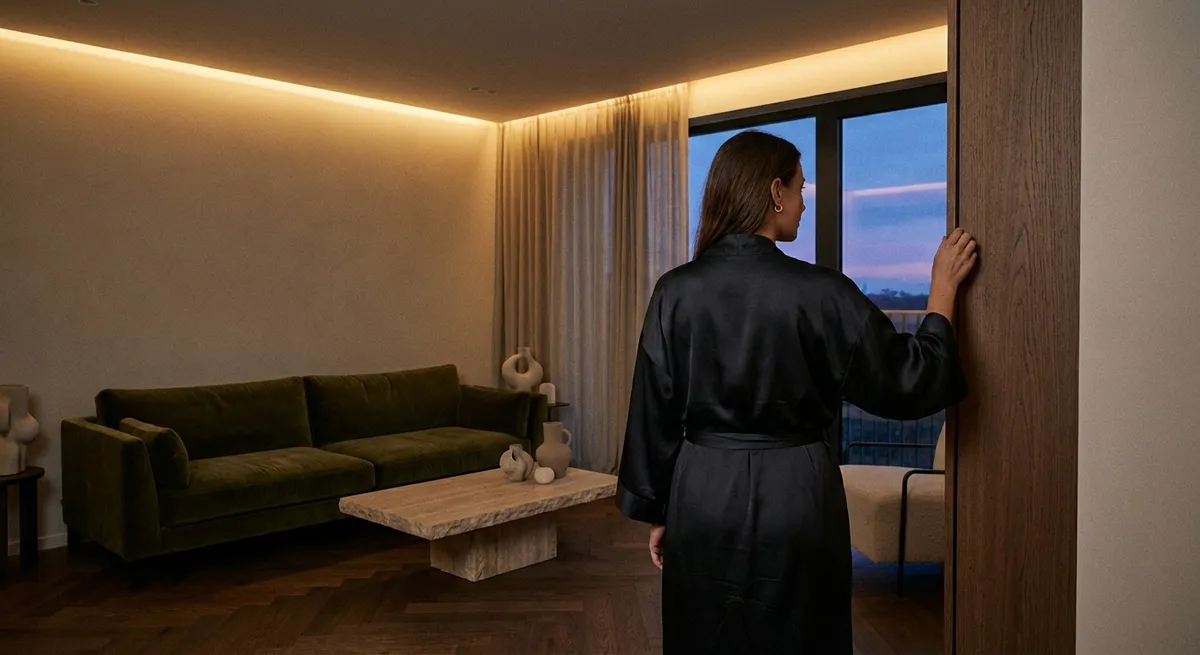
During renovation planning, this means prioritizing infrastructure: conduits in walls and ceilings for future cabling, recessed pockets for motorized shades, in‑ceiling or in‑wall speakers, and ventilation grilles that align with ceiling battens or disappear into joinery. Smart lighting control is being used not for theatrical color changes, but for elegant pre‑set “scenes” that subtly adjust intensity and warmth from morning to evening. Wall‑mounted screens are increasingly being framed, recessed, or concealed behind sliding panels so that living spaces read as rooms, not media centers. For homeowners, the strategic decision is to invest quietly in backbone systems—wiring, networking, and control—so the home can evolve technologically without sacrificing its visual serenity.
5. The Cultivated Outdoor Room: Landscape as an Interior Finish
The most sophisticated renovations now treat outdoor space as a fully articulated “room,” planned in tandem with interior architecture rather than as an afterthought. The line between inside and out is being managed not just with large openings, but with a choreographed continuity of material, level changes, and vantage points.
Underfoot, exterior pavers often echo the interior flooring in color and proportion, even if the material composition changes for durability. Built‑in benches, planters, and fireplaces are given the same level of detailing as interior joinery, allowing terraces and balconies to function as secondary living rooms rather than leftover patio space. Planting design leans toward sculptural forms and varied foliage textures instead of purely floral displays, creating a year‑round “view composition” from key interior positions—kitchens, dining tables, home offices, and bedrooms. For renovators, integrating landscape early in the design brief is no longer optional; it is essential to achieving a home where every window frame captures something intentional, and where the garden operates as an additional, tactile layer of interior design.
Conclusion
The most resonant homes emerging today share a common thread: they whisper rather than shout. They privilege thresholds over feature walls, refined utility over show kitchens alone, material continuity over accumulation, invisible infrastructure over gadgetry, and cultivated outdoor rooms over generic “yards.”
For homeowners on the verge of renovation, aligning with these quieter, more architectural currents is less about chasing fashion and more about building a future‑proof framework. When planning decisions are guided by proportion, continuity, and discretion, the result is a home that does not merely look current—it feels composed, humane, and incrementally better with every year lived in.
Sources
- [American Institute of Architects – Home Design Trends Survey](https://www.aia.org/resources/65068-home-design-trends-survey) – Industry insights on emerging residential design priorities and how homeowners are reshaping their spaces
- [Harvard Joint Center for Housing Studies – Improving America’s Housing](https://www.jchs.harvard.edu/research-areas/remodeling) – Research on renovation patterns, spending, and how homeowners invest in long‑term improvements
- [U.S. Department of Energy – Energy Saver: Smart Home Systems](https://www.energy.gov/energysaver/smart-home-systems) – Guidance on integrating efficient, unobtrusive home technologies into renovation plans
- [Royal Horticultural Society – Garden Design Advice](https://www.rhs.org.uk/garden-design) – Best practices for creating intentional, year‑round outdoor spaces that complement interior design
- [MIT School of Architecture + Planning – Design and Computation Publications](https://sap.mit.edu/research/design-computation) – Explorations of how design, technology, and spatial experience intersect in contemporary architecture
Key Takeaway
The most important thing to remember from this article is that this information can change how you think about Design Trends.