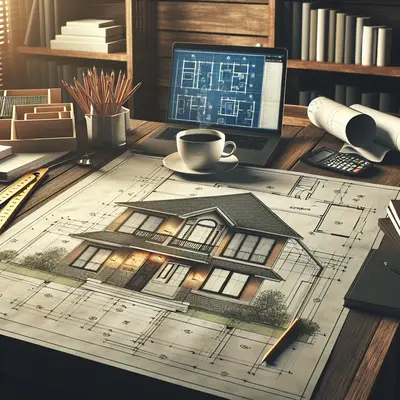
A truly elevated renovation does not begin with finishes, fixtures, or even floor plans. It begins with a quiet, rigorous blueprint for decision-making itself. When project planning is handled with the same care as design, timelines shorten, budgets behave, and the finished home feels not just beautiful, but inevitable—almost as if it were always meant to be that way. This is the discipline of refined renovation planning: orchestrating people, information, and timing so that every choice appears effortless to everyone but you.
Planning as a Design Instrument, Not an Administrative Task
Most homeowners treat planning as a prelude quickly rushed through to “get to the real work.” Discerning renovators understand that planning is itself a design instrument—one that shapes what is possible long before a single wall is opened.
Instead of focusing only on drawings and quotes, consider how decisions will actually flow over the life of the project. Who has authority on site when you are unavailable? How will scope changes be evaluated—emotionally, financially, and structurally—before they are approved? What is the agreed process when site conditions contradict assumptions on the plans?
Document these mechanisms in writing as part of your project brief, and treat them as you would a specification schedule. When your architect, builder, and designer know precisely how decisions are made and communicated, you replace the chaos of ad hoc conversations with a predictable, almost serene operational rhythm. Planning, in this sense, becomes a form of invisible architecture governing how the renovation unfolds.
Exclusive Insight #1: Design the Order of Decisions, Not Just the Design Itself
Elegant projects are not defined only by taste, but by sequencing. One of the subtle markers of an amateur renovation is decision fatigue: you are asked to approve paint colors before you have seen daylight in the space, or to select kitchen hardware before appliances are finalized.
Reverse this by deliberately designing the order of decisions in partnership with your design and build team. Begin with the structural and spatial commitments that are expensive to reverse: layout changes, window and door repositioning, mechanical systems, and major infrastructure like plumbing runs or electrical upgrades. Only when these are resolved should you transition to surfaces, joinery details, and finally decorative and hardware decisions.
Create a master “decision calendar” aligned with your construction program. Each week should have a precise set of choices to be locked in, with clear information provided in advance: drawings, samples, and cost implications. This orchestrated sequence protects you from impulsive choices made under pressure, while giving artisans enough lead time to deliver bespoke solutions. The result is a renovation that feels composed rather than cobbled together.
Exclusive Insight #2: Treat Time as a Primary Material
In refined renovation planning, time is as consequential a material as stone, timber, or brass. Ignoring it or compressing it recklessly leaves visible fingerprints: rushed tile layouts, compromised joinery, or last-minute substitutions when custom pieces cannot be fabricated in time.
Begin by asking your team not, “How quickly can this be done?” but “What is the timeline for doing this properly—including contingencies?” Request a program that openly acknowledges long-lead items such as bespoke joinery, imported stone, specialty lighting, and custom metalwork. Then buffer this program with deliberate slack at critical junctions: between demolition and framing (for unforeseen conditions), between rough-in and plaster (for layout adjustments), and between installation and handover (for refinement and corrections).
Protect those buffers rigorously. It is tempting to trade them away when early stages slip, but the most sophisticated projects defend the final weeks of finishing and detailing as sacred. This is when misalignments are corrected, finishes are finessed, and the difference between “nicely done” and “immaculate” is established. Planning time as a precious resource—rather than an inconvenient constraint—allows craftsmanship to reach its potential.
Exclusive Insight #3: Curate Your Team as Carefully as Your Materials
For premium projects, the team you assemble is your most consequential design decision. The finest stone will still look ordinary in the wrong hands; a modest material can appear elevated when installed with exceptional skill and restraint.
During planning, approach team selection as curation rather than procurement. When interviewing architects, designers, and contractors, look beyond portfolios and price. Ask how they prefer to communicate; what their last schedule overrun taught them; how they document variations; how they handle conflict among trades; and what projects they are most proud of and why. You are not only testing competence, but compatibility with your own temperament and expectations.
Once selected, bring your key professionals together at the planning stage rather than in isolation. Invite your architect, interior designer, and builder into structured early conversations so that aesthetic aspirations, practical constraints, and cost realities converge while ideas are still malleable. A contractor who understands the design intent from inception is more likely to protect it when inevitable compromises arise. This integrated planning phase transforms your project from a sequence of handoffs into a coherent collaboration.
Exclusive Insight #4: Build Financial Grace Into the Plan—Quietly
Sophisticated homeowners know that cost control is less about austerity and more about intentionality. The aim is not to spend less, but to spend precisely—reserving budget for the details that genuinely matter to you, while declining those that do not.
In planning, go beyond a single “top-line” budget. Request layered cost visibility: a base build price, an itemized schedule of finishes and fixtures, and an explicit provisional sum for unknowns (particularly in older properties). Then, create a dedicated “discretionary refinement” allowance: a quiet reserve you can draw on if an extraordinary material opportunity or artisanal detail emerges during the process.
Equally important is deciding in advance where you are prepared to be flexible. Perhaps you will not compromise on window quality or bespoke joinery, but you are open to more modest tile in secondary spaces. Document these non-negotiables and flex zones, and share them with your team at the outset. By planning your financial boundaries with nuance, you empower your professionals to propose intelligent trade-offs rather than blunt cost-cutting when pressure arises.
Exclusive Insight #5: Plan for How the Home Will Age, Not Just How It Will Photograph
Many renovations are planned around the moment of completion—the styling, the photographs, the reveal. More considered projects are planned around years of daily use: changing family needs, evolving technologies, and the quiet patina of time.
During the planning phase, invite your team to consider the house at 5, 10, and 20 years. How might household composition change? Which spaces should be easily adaptable—home office to guest room, playroom to study, media room to library? Where can you embed infrastructure that will not be used immediately but will be invaluable later—conduits for future wiring, structural provisions for potential extensions, or blocking for future grab bars in bathrooms?
Equally, consider how materials and details will age. Some clients prefer the pristine; others appreciate patina. Planning with this in mind may lead to specifying finishes that tolerate gentle wear with grace, or to designing joinery and built-ins that can be refinished or reconfigured without invasive construction. A renovation planned for longevity not only feels more intelligent—it protects the investment of both capital and attention you have made.
Turning Intention Into an Executable Plan
A premium renovation is not defined solely by an impressive brief or alluring mood board. Its quality is encoded in the invisible systems established during planning: how decisions are staged, how time is reserved for excellence, how the team is selected and aligned, how financial choices are framed, and how the future is quietly accommodated.
Treat your planning phase as the most critical design stage of the project. Give it the time, thought, and seriousness it deserves, and insist that your professional partners do the same. When planning becomes a disciplined craft rather than a rushed administrative hurdle, the renovation that follows feels less like a construction project and more like the careful unfolding of a considered vision—one that will continue to make sense, and give pleasure, long after the last trade leaves the site.
Sources
- U.S. Department of Housing and Urban Development – Rehab and Renovation - Overview of federal renovation programs and considerations that influence project planning and financing
- Harvard Joint Center for Housing Studies – Improving America’s Housing - Research and reports on remodeling trends, costs, and homeowner behavior
- National Association of Home Builders – Remodeling - Industry guidance on remodeling practices, project planning, and working with professionals
- American Institute of Architects – Working with an Architect - Framework for organizing project phases, defining scope, and structuring collaboration
- Better Business Bureau – Hiring a Contractor - Practical criteria and due-diligence steps for selecting renovation professionals
Key Takeaway
The most important thing to remember from this article is that this information can change how you think about Project Planning.