The internet is currently obsessing over “27 Ways To Get Your House In Order Now, Because We All Know Christmas Is About To Undo It All” — a viral reminder that no matter how curated your home feels in October, December will test every square inch of it. The piece taps into a familiar anxiety: a beautiful house that collapses under the weight of real life the moment guests, gifts, and glitter show up.
At Renovate Quotient, we see the same story play out in renovations. People design for how their homes look on a quiet Tuesday, not for what happens when twelve relatives arrive early, five suitcases land in the hallway, and someone opens every cabinet in search of a serving platter. The most elegant homes this season are not the ones that look perfect on Instagram; they’re the ones that remain composed when Christmas tries to undo them.
Below are five renovation-level strategies to build that kind of quiet resilience into your home — so order, not chaos, becomes your default setting, no matter how festive the storm.
1. Design “Arrival Sequences,” Not Just Entryways
The viral pre-Christmas organization article is essentially about triage: where things land when life speeds up. Renovation is your opportunity to solve that upstream. Instead of thinking in terms of a single “entryway,” design a full arrival sequence that calmly absorbs coats, boots, parcels, and people.
Begin at the door: a recessed mat set flush into the floor, generous hard-surface flooring that can take melting snow, and lighting that brightens from outside in, rather than a harsh single overhead. Then think beyond the threshold. A built-in bench with concealed shoe drawers, wall-to-wall shallow cabinetry for coats and bags, and a dedicated tray or drawer for keys, wallets, and earbuds transform the first three meters of your home into a controlled buffer zone.
For homes without a formal mudroom, build a “stealth vestibule” into your renovation plans: a niche off the main corridor with full-height storage, a mirror, and integrated charging within drawers. When guests arrive en masse over the holidays, everything they bring in has a dignified, intentional place to land. The elegance isn’t just visual; it’s behavioral. You’re quietly choreographing how people move through your space.
2. Concealed Capacity: Storage That Anticipates Seasonal Overflow
Today’s trending organizing tips are full of quick fixes: bins, baskets, and labels. Those are helpful, but they’re symptomatic solutions. Renovation lets you do something infinitely more luxurious: build in capacity that disappears when you don’t need it.
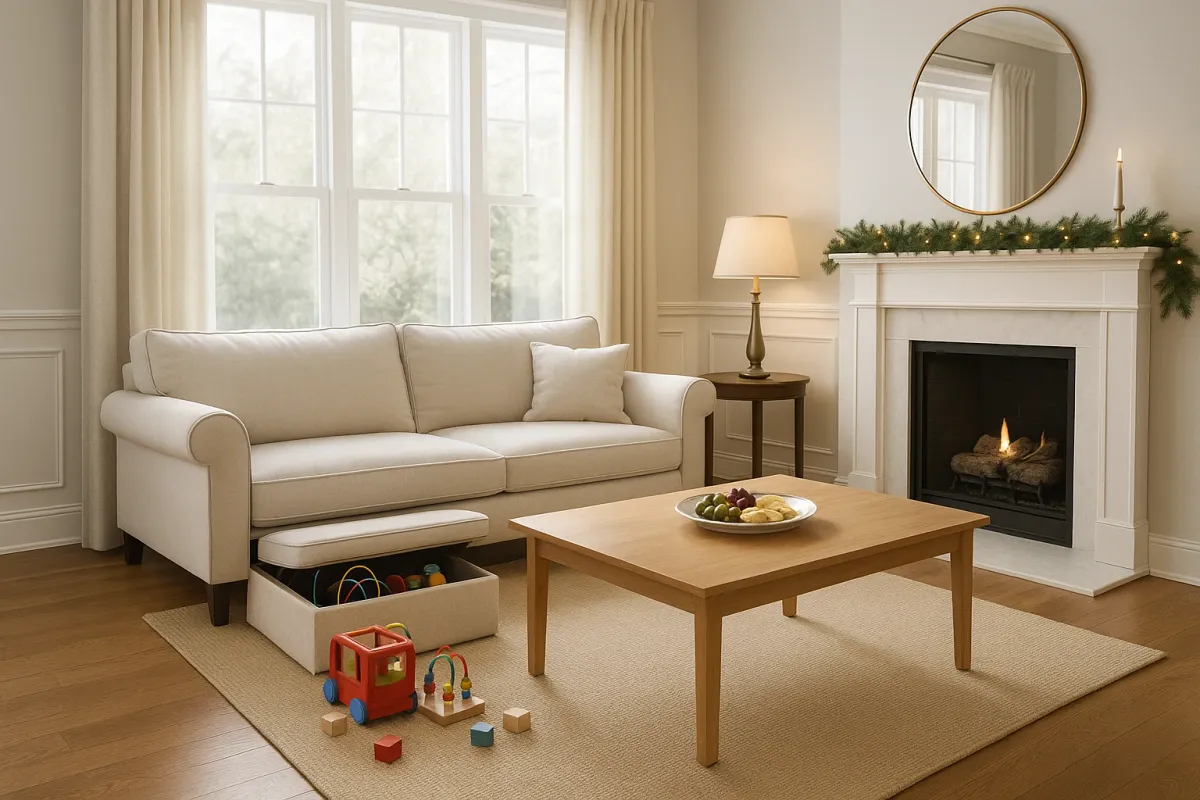
Consider your living room. For eleven months of the year, it hosts quiet evenings; for one, it must also host extended family, overflow gifts, and seasonal decor. Specify full-height cabinetry with panel fronts that visually read as wall cladding. Inside, design for multiple “modes”: shelves with adjustable heights for board games and boxes, pull-out trays for candles and ornaments, and a dedicated “wrapping station” drawer with dividers, scissors, and ribbons.
In bedrooms and guest suites, commission headboards with integrated side cabinets and under-bed drawers that are elegant enough to live with year-round but volumetric enough to absorb the inevitable holiday explosion of luggage and layers. In the dining zone, a credenza or built-in buffet with deep drawers for linens and serveware means seasonal pieces aren’t orphaned in remote storage — they appear only when the calendar calls for them.
The real luxury isn’t simply having more storage; it’s that your home never looks like it’s working as hard as it actually is.
3. Zoning for Noise, Warmth, and Flow — Not Just Square Footage
The pre-Christmas panic is rarely only about clutter; it’s about too many activities fighting for too little space. Viral checklists tell you to “clear the hallway” or “pre-plan the guest bed,” but a refined renovation goes further and designs distinct behavior zones that prevent friction before it starts.
When reconfiguring layouts, think about three invisible layers: noise, warmth, and circulation. Position the loudest zones — kitchen, playroom, media space — so their acoustic impact can be softened with pocket doors, deeper walls, and fabric-rich surfaces. Allocate a “quiet lounge” or snug away from the main social axis, ideally near a window or fireplace, so one or two people can escape without leaving the party.
For flow, sketch how people will actually move when the house is full: from kitchen to dining to seating, from entry to tree to terrace. Avoid narrow pinch points around islands and table corners; consider rounded edges and a minimum of 110–120 cm clearances in high-traffic paths. Thoughtful placement of a second, small handwashing sink or a bar niche in the dining area can prevent holiday bottlenecks at the main kitchen sink.
Zoning for thermal comfort is equally critical. When more bodies are in a room, it warms rapidly. Radiant floors, smart zoning of underfloor heating, and discreet ceiling fans set to winter mode keep temperature gradients comfortable without throwing open windows in mid-December.
4. Entertaining-Focused Kitchens That Still Live Beautifully Monday–Friday
The seasonal organizing article reflects a truth: December is when your kitchen is stress-tested. But designing purely as a “chef’s kitchen” can be a trap if it ignores how people actually gather. The most sophisticated renovations now mirror hospitality design — quietly borrowing from boutique hotels and private clubs.
First, separate “working” and “social” counter space. An island with a sculptural stone slab and concealed power can serve canapés, mix drinks, and host grazing boards without intruding on the cooking line. Position the primary prep zone and cooktop on a back run, ideally with a slightly taller upstand or low ledge that screens the inevitable mess from the main living area. This preserves a serene visual field, even mid-feast.
Second, treat appliance exposure as a design decision. A fully integrated fridge disappears behind millwork, while a secondary under-counter beverage cooler, positioned away from the chef’s path, lets guests help themselves without clogging the cook’s triangle. If your renovation allows, a compact “back kitchen” or pantry with a second dishwasher becomes the true workhorse, making it effortless to reset between courses or events.
During the rest of the year, this layout still feels indulgent: weekday cooking is calmer, and surfaces stay clearer because every appliance has a home, not a corner.
5. Aesthetic Consistency That Survives Seasonal Layers
One of the most shared sentiments in the “27 Ways…” article is the dread of decor that makes your home feel unlike itself for a month. Effective renovation anticipates this by designing a calm visual architecture that can absorb, not fight, seasonal layers.
Start with a controlled materials palette: limit fixed finishes to a few, deeply harmonious tones and textures. Think oak and limestone with soft bronze, or walnut and plaster with blackened metal. Then integrate subtle motif repetition — a particular curve in your door profiles echoed in your fireplace opening or light fixtures. When holiday pieces arrive, they sit against a coherent backdrop, not a visual argument.
Plan touchpoints for decoration in advance. A generous mantel with concealed micro power for fairy lights, a ledge in the entry sized for seasonal arrangements, and dining room walls designed to hold art or a temporary wreath installation ensure that festive elements feel curated, not ad hoc. Incorporate discreet storage near each of these zones for their off-season lives, so decor doesn’t migrate to random closets and resurface creased and chaotic next year.
The most refined homes can move from November minimalism to December abundance and back again without ever feeling disjointed. Renovation is the moment to script that annual transformation.
Conclusion
As the internet trades tips on how to survive the oncoming holiday whirlwind, the deeper conversation is about homes that are either fragile or robust under pressure. The trending “get your house in order now” mindset is a useful prompt — but it’s also an invitation to think bigger.
A premium renovation doesn’t merely give you prettier rooms; it gives you a more composed life when those rooms are most in demand. By designing arrival sequences, concealed capacity, considered zones, entertaining-ready kitchens, and a visual language that welcomes seasonal change, you create a home that stays serene even when the calendar doesn’t.
In a season defined by excess, true luxury is not having less going on. It’s a space so intelligently crafted that, no matter how much is happening, it still feels effortlessly in order.
Key Takeaway
The most important thing to remember from this article is that this information can change how you think about Home Renovation.