A truly refined renovation is rarely about spectacle; it is about orchestration. The most successful projects feel inevitable, as though the home could never have been anything else. Behind that quiet inevitability lies a series of deliberate, often invisible choices that separate the ordinary upgrade from the genuinely exceptional transformation. For homeowners planning a renovation at a higher level, understanding these subtleties is the difference between “beautiful for now” and “effortlessly enduring.”
Below are five exclusive, under-discussed insights that sophisticated renovators and design professionals quietly rely on—each one capable of elevating a project from well-executed to impeccably composed.
1. Designing for the Eye’s Journey, Not Just the Floor Plan
Most renovation planning stops at function: where walls move, where storage goes, how circulation works. What often goes unconsidered is the choreography of perception—the precise way your eye travels the moment you enter a space.
A refined renovation starts by mapping sightlines before moving a single wall. Stand at the main entry, the kitchen threshold, the primary bedroom door. What is the first thing you see? Is it a refrigerator side panel, or a curated vignette—a framed view to a garden, a fireplace, a sculptural light, or a beautifully proportioned window? These focal anchors determine how expensive or modest the entire space feels.
Elevated projects also pay attention to layered depth: foreground (entry console, island, or dining table), midground (seating, architectural detailing), and background (windows, art, long vistas). Even in compact spaces, creating intentional depth with aligned openings, framed views, and controlled visual “pauses” gives the home a sense of calm generosity. The best designers are ruthless about removing visual clutter from key sightlines, hiding functional elements just out of frame so that the experience of the room is pure, composed, and quietly cinematic.
2. The Precision of Proportion: Millimeters That Change the Mood
While mood boards and color palettes tend to command attention, the true luxury of a renovation often reveals itself in proportion. The thickness of a countertop edge, the height of a baseboard, the reveal around a door frame—these choices are rarely discussed on social media, yet they dictate whether a space feels bespoke or generic.
Consider cabinet proportions: standard off-the-shelf modules can produce a visually “noisy” elevation. A disciplined grid—aligned door rails, consistent verticals, and the intentional grouping of drawers—reads as calm and sophisticated. Similarly, playing with scale in a controlled way (a slightly oversized island slab, an elongated fireplace opening, or taller-than-standard interior doors) can make the room feel more architecturally important without adding ornament.
The interplay between elements matters as much as their individual sizes. A tall baseboard paired with a slender window casing, or a generous crown with a simple flush door, can create an elegant balance of visual weight. The guiding principle: fewer moves, executed with extreme precision. In high-end projects, millimeters are debated, not dismissed—they are the quiet authors of perceived quality.
3. Material Storytelling: Composing a Cohesive Palette Across the Entire Home
Most homeowners choose materials room by room. Exceptional renovators, however, compose a material narrative that flows through the entire home. The question is not “Which tile for this bathroom?” but “What is the language of this house, and how does each room speak a dialect of that same language?”
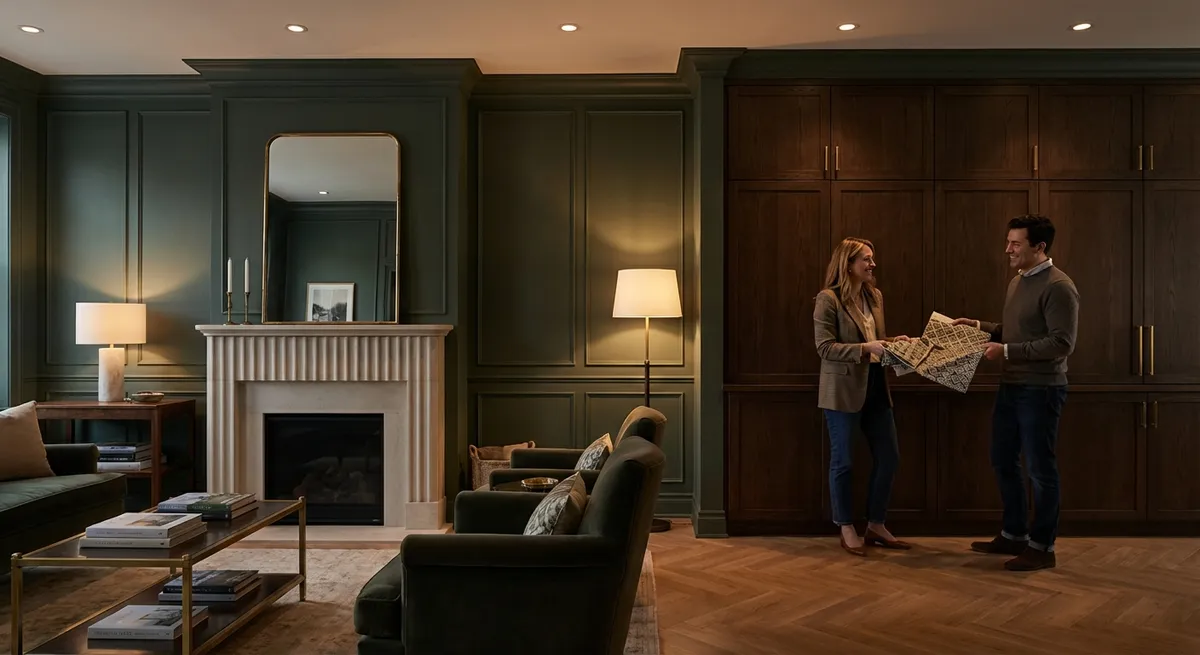
Begin by defining a primary material family—perhaps warm oak with honed limestone and brushed nickel, or walnut with plaster and patinated brass. From there, establish three tiers: foundational materials (floors, major surfaces), secondary accents (cabinetry, stone, hardware), and tertiary details (textiles, small fixtures). The goal is not to repeat the same finish everywhere, but to allow each choice to feel like a variation on a theme, much like a well-designed hotel or gallery residence.
Restraint is crucial. Rotating through too many unrelated materials can cheapen even an expensive renovation. Instead, adjust finish (honed vs. polished), scale (large format vs. mosaic), and application (vertical vs. horizontal surfaces) within a contained palette. Over time, this creates a sense of continuity that makes the home feel larger, more deliberate, and significantly more luxurious.
Thoughtful transitions are where material storytelling truly shows: the way a stone threshold meets timber, how tile terminates into painted wall, or how a stair handrail changes from wood to metal. These seams signal to the perceptive guest—and to you every day—that the renovation was conceived holistically, not piece by piece.
4. Strategic Obscurity: Hiding the Ordinary to Elevate the Exceptional
Luxury in renovation is as much about what you don’t see as what you do. The most refined spaces rigorously conceal the mundane: utility lines, everyday appliances, cleaning supplies, charging cables. This is not merely aesthetic minimalism; it is a strategy that allows key features to command full attention without competition.
Appliance garages, integrated panel-ready refrigerators, flush-mounted access panels, and concealed laundry zones are standard in elevated projects, but the thinking goes further. Where is the vacuum stored so it is both accessible and invisible? Can the guest bath hide a modest storage cabinet behind a mirror? Can a wall niche accommodate everyday clutter before it reaches the countertop?
Lighting control and technology also benefit from this philosophy of strategic obscurity. Centralized control systems, discreet wall plates, and carefully located outlets maintain clean lines. Similarly, HVAC grilles aligned with architectural geometry—or integrated into shadow reveals—prevent a visually fractured ceiling. When executed well, the result is not an antiseptic home, but one in which the ordinary logistics of living are gently, intelligently edited out of the visual field.
5. Designing for Time: Patina, Adaptability, and the Future Owner
A truly cultivated renovation is not optimized for listing photos next month; it is calibrated for elegance over time. This mindset reshapes countless decisions, from material selection to mechanical planning and even spatial strategy.
Materials that age gracefully—solid wood, natural stone, high-quality hardware, limewash or plaster, wool textiles—develop character instead of decay. Accepting and designing for patina (rather than fighting it with synthetic finishes) is a hallmark of higher-end work. A honed stone island that softens with subtle etching, or a brass handle that deepens with use, tells a story of lived-in luxury.
Adaptability is equally important. Can a home office easily convert to a nursery or guest suite? Can a generous pantry later become a small workspace, or a sitting room be reconfigured for aging in place? Building in flexible infrastructure—extra power, blocking in walls for future grab bars or built-ins, slightly wider doorways—quietly future-proofs the home without visually announcing it.
Finally, consider the “future custodian” of your home. Overly personalized structural moves can diminish long-term appeal, whereas decisions rooted in solid planning, quality construction, and timeless proportion tend to retain value. The cultivation of a home that can elegantly outlast trends is, in itself, a mark of sophistication.
Conclusion
Refined renovation is less about dramatic before-and-after moments and more about layered, intelligent decisions that rarely appear in the headlines of design blogs. When you design for the eye’s journey, obsess over proportion, choreograph a continuous material story, conceal the ordinary, and plan for the long arc of time, your home begins to operate at a different level—quietly luxurious, deeply considered, and surprisingly resilient to passing fashions.
For homeowners prepared to invest not just money but discernment, these five nuances become powerful instruments. They transform a renovation from a project you complete into a place you inhabit with enduring confidence—a home that feels, in every carefully edited detail, unmistakably intentional.
Sources
- American Institute of Architects (AIA) – Home Design Trends Survey – Insights into long-term residential design patterns and homeowner priorities
- Harvard Joint Center for Housing Studies – Improving America’s Housing – Data and analysis on renovation spending, quality, and long-term value
- U.S. Department of Energy – Energy Saver: Home Improvement – Guidance on integrating efficient systems and infrastructure planning into renovations
- National Association of Home Builders – Design Trends – Research-based perspectives on evolving residential design, materials, and features
- Royal Institute of British Architects (RIBA) – House Design Guides – Professional guidance on proportion, layout, and architectural detailing in residential projects
Key Takeaway
The most important thing to remember from this article is that this information can change how you think about Home Renovation.