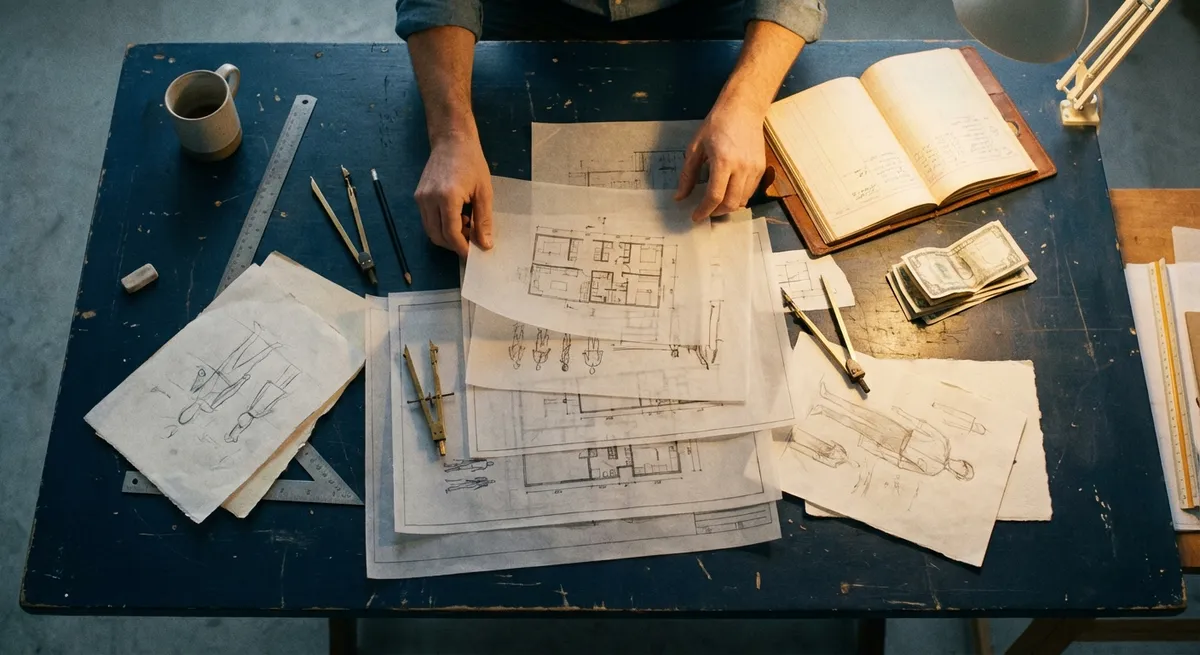
A renovation budget, in practiced hands, is not a constraint but a composition. It shapes what deserves emphasis, what recedes to the background, and where the visual “soloists” of your home will stand. For homeowners with a cultivated eye, managing budget is less about cutting costs and more about orchestrating value—deciding where to be unapologetically generous and where to be quietly restrained. When approached with intent, your financial framework becomes a design tool as powerful as any architect’s pen.
Below, we explore a refined approach to budget management, anchored by five exclusive insights that sophisticated renovators use to align investment with enduring impact.
Reframing the Budget as a Design Brief
Most renovation budgets read like a spreadsheet; the most successful ones read like a manifesto.
Rather than beginning with line items, begin with a hierarchy of experiences you want your home to support: unhurried mornings, effortless entertaining, discreet storage, calm transitions between public and private spaces. From there, you translate experiences into investment priorities. Perhaps the morning ritual points you toward an exceptional primary bathroom; entertaining suggests a generous, well-lit kitchen with intuitive circulation.
By tying each major allocation to a lived experience, you avoid the drift toward impulse decisions—those seductive but ultimately nonessential upgrades that creep in at the margin. Your budget becomes a narrative, not a list. Each figure answers a question: what is this line item supposed to make feel different, easier, or more elevated? If you can’t answer that clearly, the allocation can likely be trimmed or redirected.
This reframing also makes conversation with your designer and contractor more productive. Instead of reacting only to costs, you’re collectively evaluating whether each number serves the story you are consciously writing for your home.
Insight 1: Invest Where the Hand and the Eye Meet
In a refined renovation, the most intelligent spending focuses on the points where people repeatedly touch, see, and move through the space. These are the “high-frequency contact zones”: door hardware, faucet levers, stair handrails, countertops, banisters, and the surfaces you brush against daily.
A modest upgrade in these tactile elements often yields an outsized impression of quality. A solid, well-balanced door handle, a precisely machined faucet, or a finely finished stair rail communicates craftsmanship each time it’s used. Conversely, skimping here can quietly diminish the perceived caliber of an otherwise expensive renovation.
This doesn’t mean everything must be top-tier. Rather, designate select touchpoints for premium investment and support them with well-chosen mid-range pieces elsewhere. A sense of coherence is achieved not by uniform pricing, but by consistent intentionality. When the hand and eye both register care, the entire home reads as elevated—even if some invisible components came from the sensible portion of the budget.
Insight 2: Use “Hidden Generosity” to Avoid Visible Regret
There is a certain luxury in what is never seen but always felt. Structural integrity, sound insulation, proper waterproofing, and efficient mechanical systems are most appreciated in their absence of drama: no leaks, no drafts, no ambient clatter from upstairs.
Sophisticated homeowners allocate meaningful budget to these hidden layers because they understand the cost of neglect. Correcting poor waterproofing or inadequate ventilation after finishes are installed is exponentially more expensive—and more intrusive. A quiet home with stable temperatures and clean air feels premium regardless of its square footage.
Strategically, this means running your budget in two parallel columns: visible statement and invisible assurance. Before enlarging a window or changing a layout, ensure that essentials—roofing, subfloor preparation, proper drainage, electrical capacity—are fully and correctly funded. The most regretted overspend usually happens when aesthetic flourishes are prioritized before the basics are truly secure.
The refinement comes not from avoiding visible luxuries, but from ensuring that what lies beneath them is built to last. Hidden generosity protects everything you will later showcase.
Insight 3: Treat Time as a Silent Line Item
Most homeowners view budget purely through the lens of money, yet time is the second currency that can quietly erode value. Delays, rushed decisions, and out-of-sequence work often manifest as financial overages.
A cultivated approach to budgeting acknowledges time as a cost category:
- Decision time: Appliances, fixtures, stone slabs, and custom cabinetry often have long lead times. Making these selections early can prevent last-minute substitutions and rushed compromises that either inflate cost or dilute quality.
- Contingency time: Building in buffer periods around inspection milestones and critical deliveries helps avoid “premium pricing” for emergency labor or expedited shipping.
- Living-time impact: If you’re remaining in the home during renovation, extended timelines have indirect costs—temporary accommodations, storage, or simply the mental toll of prolonged disruption.
Integrating time into your budget conversations reshapes decisions. Paying slightly more now for a product or trade that keeps the schedule intact may be more economical than a cheaper alternative that traps the project in delay. In sophisticated renovations, calendar and cashflow are managed as interdependent elements, not separate concerns.
Insight 4: Compose Contrast Between Signature and Supporting Elements
Exceptional renovations rarely distribute money evenly. They create deliberate contrast between a few “signature” elements and a quietly supportive background.
Think of your home the way a curator thinks of a gallery: a small number of standout pieces deserve the spotlight—a sculptural light fixture, a monolithic stone island, bespoke millwork in an entry, or a meticulously detailed fireplace. Around these, the supporting elements are intentionally calm, refined, and more cost-conscious: simple tile in secondary bathrooms, standard interior doors with one upgraded hardware finish, or well-made but unpretentious cabinetry in non-public zones.
From a budget perspective, this strategy prevents the common trap of mid-range everything—where costs escalate with limited visual or experiential payoff. By pre-selecting areas for true distinction and consciously de-emphasizing others, you funnel budget into moments that are actually memorable.
Sophisticated homeowners often identify these signature zones early: the first view when you open the front door, the main axis of the living space, or the transition from public to private areas. Once these “power vignettes” are defined, every line item is evaluated for its role—either as a star or as a quiet support.
Insight 5: Reserve a “Adaptive Capital” Pool for Live Discoveries
No matter how well your project is planned, the renovation itself will surface ideas you simply couldn’t have imagined on paper: a beautiful brick wall uncovered during demolition, unexpected ceiling height that invites a different lighting concept, or an opportunity to reconfigure a small area for much better storage.
Savvy renovators anticipate the creative potential of discovery and protect it by reserving a specific portion of the budget as adaptive capital—separate from standard contingency for problems. Contingency addresses the unpleasant surprises; adaptive capital funds the inspired ones.
Psychologically, this buffer changes the tone of mid-project decisions. Instead of resenting every new possibility as a “cost increase,” you can evaluate it as a deliberate choice: is this discovery worth spending from our adaptive capital? If not, you preserve it for a later, more compelling opportunity.
The discipline is in defining this pool from the outset—typically in the range of a small percentage of the total budget—and being honest with yourself about what it is for. When managed well, adaptive capital is how exceptional renovations acquire their most memorable, site-specific nuances without blowing past their financial guardrails.
Conclusion
Budget management in a refined renovation is less about austerity and more about orchestration. When you treat your budget as a design instrument, you shift from defending every expense to curating every investment. You channel resources into the surfaces your hand will touch daily, the silence you will enjoy because of proper insulation, the timeless moments shaped by signature elements, and the creative opportunities that emerge midstream.
The result is not simply a home that “came in on budget,” but one where every dollar feels present in the experience of living there—quietly, consistently, and with an elegance that endures long after the final invoice is paid.
Sources
- [U.S. Department of Energy – Energy Saver](https://www.energy.gov/energysaver/energy-saver) - Guidance on insulation, HVAC efficiency, and building systems that supports smart “hidden” investments behind the walls
- [National Association of Home Builders (NAHB) – Remodeling](https://www.nahb.org/advocacy/industry-issues/remodeling) - Industry insights on renovation best practices, cost considerations, and planning fundamentals
- [Houzz & Home Renovation Trends Study 2024](https://www.houzz.com/magazine/houzz-research) - Data-driven look at how homeowners are currently budgeting, prioritizing spaces, and handling contingencies
- [Consumer Reports – Guide to Kitchen and Bath Remodeling](https://www.consumerreports.org/home-garden/kitchen-remodel/guide-to-kitchen-remodeling-a8347747075/) - Independent testing and advice on where to splurge or save on key fixtures and finishes
- [Harvard Joint Center for Housing Studies – Improving America’s Housing](https://www.jchs.harvard.edu/research/improving-americas-housing) - Research on long-term renovation trends, spending patterns, and value drivers in residential upgrades
Key Takeaway
The most important thing to remember from this article is that this information can change how you think about Budget Management.