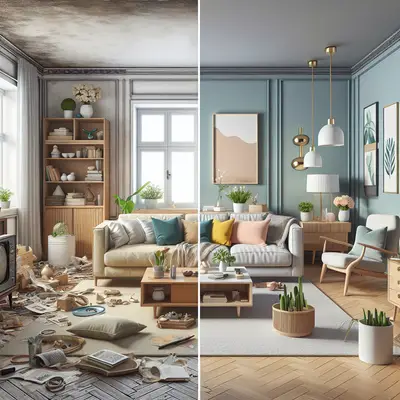
Renovation, at its highest level, is not a flurry of finishes and fixtures—it is the disciplined shaping of how a home thinks, behaves, and endures. The most successful projects share a quiet commonality: their owners leverage subtle strategic advantages that rarely appear on mood boards or contractor proposals, yet determine whether a renovation feels polished, future-proof, and effortlessly livable.
Below are five exclusive, under-discussed insights that can move your project from “well done” to fundamentally elevated.
1. Designing for the “Invisible Day”: How Your Home Performs When No One Is Looking
A refined renovation is judged less by how it photographs and more by how it performs in the unglamorous middle of the week. The “invisible day” is the Tuesday in February when groceries arrive in the rain, a child is home sick, and a work deadline looms—this is the stress test for your layout and systems.
Plan your renovation around these unremarkable yet defining moments. Where do parcels land before they’re unpacked? Does laundry circulate through public space or quietly through a secondary corridor? Is there a dedicated, closed-door zone for video calls that does not commandeer the dining table? When you script the choreography of mess, noise, and movement first, you can layer luxury materials and aesthetics onto a fundamentally calm framework.
The result is a home that appears effortlessly composed because the chaos has been thoughtfully re-routed. This is the difference between a renovated house and a well-orchestrated life that happens to take place inside one.
2. The Subtle Geometry of Circulation: Creating Flow That Feels Instinctive
Most homeowners obsess over room sizes and underplay what happens between them. The circulation paths—the literal geometry of how you move—often determine whether a space feels gracious or aggravating. High-caliber renovations treat circulation as a design discipline in its own right.
Consider line of sight, not just line of travel. Approaches to primary rooms should reveal views gradually, not dump you abruptly into the center of everything. Tweak door placements so movement has gentle curves rather than harsh 90-degree pivots at every threshold. Aim to reduce “conflict points” where someone opening a fridge intersects with someone moving through the kitchen, or where a bathroom door opens directly into public space.
Even a modest footprint can feel expansive if circulation is uncongested and intuitive. Study corridors, pinch points near islands, and bottle-necks at entries. A few inches added to a hallway, a pocket door instead of a swing, or a slightly offset opening can transform the emotional temperature of the entire floor. This is spatial finesse that rarely appears in listing descriptions, yet it is what your body notices every day.
3. Layered Light as Architecture, Not Decoration
Lighting is often treated as an afterthought—selected from a catalog after walls are framed. Elevated renovations reverse this sequence and treat light as a primary architectural element, equal in importance to layout.
Think in layers: ambient (overall), task (functional), accent (emphasis), and natural (daylight). Begin with what you want to see, do, and feel at different times of day, then script the lighting to support that mood. For example, a kitchen that doubles as an evening gathering space may need bright, even task lighting for food prep, but also a secondary, softer mode after dinner where only under-cabinet and island pendants remain on, allowing the room to glow rather than glare.
Integrate dimming as standard, not upgrade. Consider color temperature carefully: slightly warmer light in living and sleeping areas ensures a sense of ease, while neutral white in work zones keeps tasks crisp. Plan for lighting control at logical, comfortable locations—no scavenger hunt of switches—and anticipate future smart control integration, even if you install it later.
Executed well, lighting functions as silent architecture: it shapes proportion, emphasizes materials, and quietly reinforces the narrative of each room without ever calling attention to itself.
4. Material Discipline: The Edited Palette That Feels Inherently Expensive
Luxury in renovation is less about how many premium materials you use and more about how few—and how coherently. A disciplined palette, repeated with intention, reads as calm, substantial, and enduring.
Begin by selecting a primary “language” of your home: perhaps a specific wood tone, a stone family, or a metal finish that recurs subtly throughout. Aim for continuity rather than novelty. For example, using one carefully chosen natural stone in varied formats (slab countertops, honed tile, a single accent threshold) can feel far more elevated than three different stones competing for attention. Similarly, limiting metal finishes—say, warm brass and matte black only—prevents visual noise and makes each piece feel deliberate.
Texture becomes your quiet luxury. Pair smooth with tactile: a hand-troweled plaster with crisp millwork, honed stone against a soft wool rug, brushed hardware on lacquer or satin paint. This interplay gives depth without resorting to loud patterns or trends that will age quickly.
The most sophisticated renovations often appear almost minimal on paper; their richness is in nuance—the way light skims a wall finish, how a cabinet line aligns perfectly with a window mullion, how a single species of wood runs consistently through doors, flooring, and built-ins. Edit ruthlessly; completion should feel like you’ve removed the unnecessary, not that you’ve simply stopped adding.
5. Future-Proof Infrastructure: Preparing Quietly for the Next Decade
The least visible decisions in a renovation often yield the most long-term value. High-caliber homeowners treat infrastructure as an investment portfolio: planned, diversified, and focused on durability and adaptability, not instant gratification.
Prioritize the backbone—electrical capacity, insulation, envelope integrity, and mechanical systems. Upsizing the electrical panel, adding dedicated circuits, and pre-wiring for EV chargers, solar, or future smart systems may never appear in a photograph, but they preserve both resale appeal and daily convenience. Similarly, well-planned insulation and air sealing reduce operating costs and enhance comfort more reliably than any single luxury feature.
Future-proofing also means designing for evolving needs without broadcasting it. Reinforce bathroom walls now so grab bars can be elegantly added later without demolition. Ensure at least one ground-level room can convert to a bedroom with minimal modification. Incorporate subtle, wider clearances at key thresholds and around major pieces of furniture to accommodate strollers, luggage, or mobility aids without redesign.
Think of your renovation as setting up a series of options your future self can exercise when life changes. When the structure and systems are quietly intelligent, the home can evolve gracefully without crisis-level remodels every few years.
Conclusion
A truly cultivated renovation is an exercise in restraint, clarity, and foresight. Instead of chasing every design trend or indulgence, it privileges flow over footage, performance over spectacle, and enduring coherence over momentary excitement.
By designing for the “invisible day,” refining circulation, treating light as architecture, editing your material palette, and investing in future-ready infrastructure, you build a home that doesn’t merely look improved—it lives smarter, feels calmer, and stays relevant far beyond the current design cycle. That is the essence of a renovation with genuine, lasting quotient.
Sources
- [U.S. Department of Energy – Energy Saver: Home Energy Renovations](https://www.energy.gov/energysaver/home-improvement) - Guidance on improving home envelopes, insulation, and systems for efficiency and comfort
- [Harvard Joint Center for Housing Studies – Improving America’s Housing](https://www.jchs.harvard.edu/research-areas/remodeling) - Research on long-term trends and best practices in renovation and remodeling
- [American Institute of Architects (AIA) – Residential Design Resources](https://www.aia.org/resources/6400312-residential-architecture) - Insights on residential design principles, including layout, circulation, and light
- [National Kitchen & Bath Association (NKBA) – Design Guidelines](https://nkba.org/resource/kitchen-design-guidelines-with-access-standards) - Detailed standards for functional circulation, clearances, and task lighting in kitchens and baths
- [Mayo Clinic – Aging in Place: Home Modifications](https://www.mayoclinic.org/healthy-lifestyle/healthy-aging/in-depth/aging-in-place/art-20485965) - Recommendations for discreet, future-ready home features that support changing needs
Key Takeaway
The most important thing to remember from this article is that this information can change how you think about Home Renovation.