Renovation at its highest level is no longer about spectacle; it is about calibration. The most compelling homes today feel quietly resolved—spaces where every finish, junction, and line has been considered, but nothing is clamoring for attention. For homeowners planning a renovation, the opportunity is not just to refresh rooms, but to choreograph an experience: how light moves through the day, how materials age, how technology disappears into the background. Below are five exclusive insights shaping the next wave of refined residential design—each one aimed at those who prefer discernment over display.
Insight 1: The Rise of “Soft Architecture” in Everyday Rooms
Beyond walls and doors, a new layer of “soft architecture” is redefining how rooms function. Rather than relying on hard partitions, designers are using drapery, millwork, and lighting to suggest thresholds and zones without visually fragmenting space.
Floor-to-ceiling curtains—not only at windows but also to veil storage or frame openings—introduce a sense of architecture that is fluid yet deliberate. Built-in banquettes, column-like bookshelves, and fluted or slatted screens subtly imply divisions between living, dining, and working zones while preserving sightlines. Cove lighting and shadow gaps replace bulky trim, allowing ceilings and walls to read as quiet planes, uninterrupted but beautifully edged with light. For renovators, investing in these “soft” spatial moves yields homes that flex elegantly between entertaining, working, and retreat, without the clutter of temporary partitions or ad hoc furniture arrangements.
Insight 2: Material Pairings that Age with Grace, Not Just Style
The most compelling material palettes are no longer about novelty but about how they will patinate over a decade, not merely a season. The focus is on combinations that age in conversation with one another—stone, wood, metal, and plaster that each develop character without looking tired.
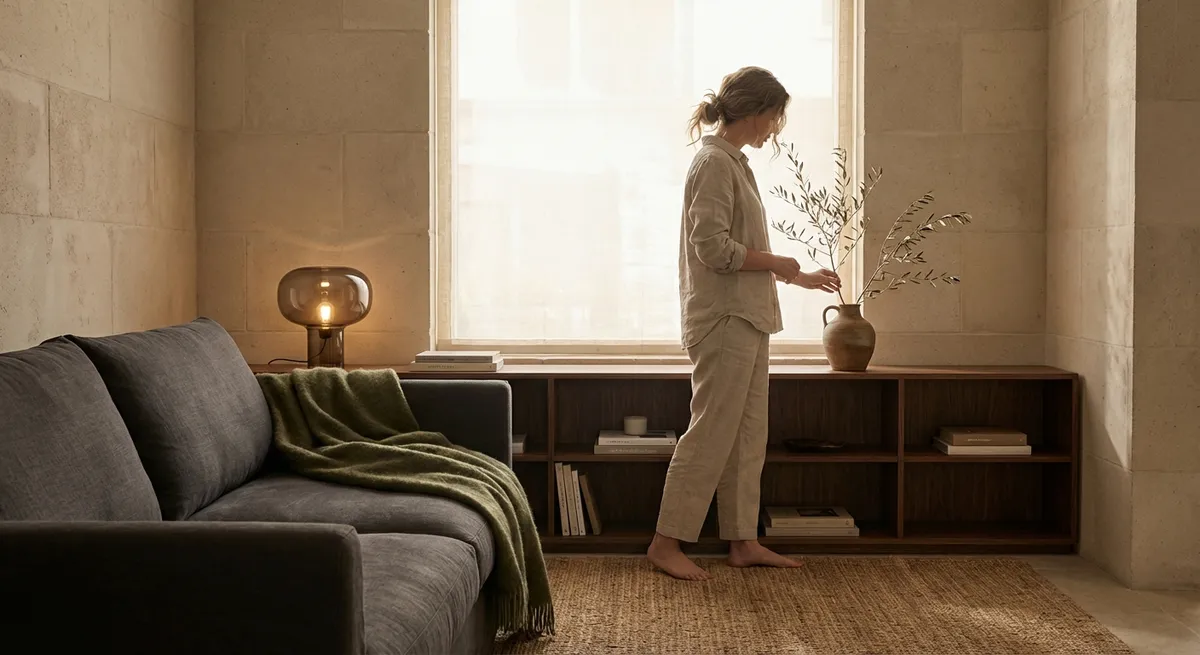
Homeowners are electing honed stone over high-gloss surfaces, accepting micro-etching and soft wear patterns as part of the story. Limewash and mineral paints introduce nuanced depth that shifts with daylight, rather than flat, uniform coverage. Woods with visible grain—white oak, walnut, ash—are finished in low-sheen oils instead of thick lacquers, allowing repairs and future refinishing to be seamless. Metals like unlacquered brass, bronze, and blackened steel are no longer relegated to “accent” roles; they are integrated in hardware, lighting, and even kitchen trims, designed to develop a muted, lived-in sheen. A thoughtful renovation considers not just how the material board looks in a presentation, but how each surface will register time, touch, and light in the years ahead.
Insight 3: “Hidden Performance” Kitchens and Baths
In high-end residential design, the most sophisticated kitchens and baths now prioritize “hidden performance”—spaces that feel calm and elegantly spare yet operate with almost professional efficiency. The luxury is in the choreography, not the clutter.
Appliances retreat behind paneled fronts, and tall storage walls conceal coffee stations, small appliances, and open shelving that can be closed off when entertaining. Sinks are oversized but visually restrained, with integrated drainboards, ledges for accessories, and flush covers that convert work zones into serving or bar surfaces. In bathrooms, wall-mounted vanities and concealed drains reduce visual noise, while thermostatic valves and digital controls deliver precision without a tangle of exposed hardware. Under-cabinet power, integrated charging drawers, and discrete task lighting mean technology is present but not prominently announced. For renovators, the guiding question becomes: how can this space quietly overperform? The answer lies in specifying mechanisms, layouts, and details that disappear, leaving a serene, visually cohesive envelope.
Insight 4: Light as a Design Material, Not an Afterthought
Lighting is evolving from “fixtures on a plan” to a primary design material with as much importance as stone or wood. The most compelling renovations treat natural and artificial light as a continuous, layered composition.
Daylight is orchestrated first—through enlarged but carefully proportioned openings, the use of interior windows or transoms to borrow light, and strategic reflective surfaces that bounce illumination deeper into spaces. Artificial lighting then complements rather than competes: ambient layers via coves and recessed channels, accent lighting that grazes textured walls or art, and smaller-scale fixtures near seating and reading areas. Color temperature consistency throughout the home creates a sense of quiet visual unity, while dimming and scene controls allow a single room to shift from work mode to evening sanctuary with a subtle adjustment. By involving a lighting designer early—or at minimum, deeply considering lighting scenarios during planning—homeowners secure one of the most underestimated luxuries: a home that looks and feels extraordinary at every hour, not just in staged daylight.
Insight 5: Intentional Quiet in an Intensely Connected Home
Paradoxically, as homes become more technologically advanced, the most refined renovations emphasize intentional quiet—visually, acoustically, and digitally. The priority is not more devices, but smarter integration and thoughtful restraint.
Sound insulation, often overlooked, is gaining the same level of attention as finishes: acoustic underlayments beneath hard flooring, insulated interior partitions between bedrooms and social spaces, and soft surfaces strategically placed to temper reverberation. Mechanicals and HVAC are specified not only for efficiency but for silence, with attention to duct design, equipment placement, and vibration control. On the digital side, robust but concealed infrastructure—structured wiring, in-wall access points, centralized hubs—supports streaming, security, and automation without visible clutter. Smart systems are chosen for reliability and intuitive control, then tucked away: touchpads that blend with wall finishes, speakers recessed into ceilings, shades that vanish into pockets. For the discerning renovator, the goal is not a “high-tech house” as a talking point, but a home that simply works so well—and so quietly—that the technology recedes into the architecture itself.
Conclusion
Refined renovation today is defined less by overt statement pieces and more by the intelligence of what is not immediately seen: the way spaces transition, the tactility of materials under hand, the stillness of a perfectly lit room with no visible source, the calm confidence of a kitchen that can shift from family hub to formal entertaining without a trace of chaos. For homeowners planning their next project, focusing on soft architecture, long-view materials, hidden performance, composed lighting, and intentional quiet will yield a home that does more than impress on move-in day. It will continue to reveal its excellence, quietly and consistently, as you live into it over time.
Sources
- Harvard Joint Center for Housing Studies – Remodeling Trends – Research and reports on renovation and remodeling patterns in U.S. homes
- American Institute of Architects (AIA) – Home Design Trends Survey – Insights from architects on emerging residential design priorities
- U.S. Department of Energy – Energy Saver: Lighting Choices – Guidance on efficient, high-quality lighting strategies for homes
- National Kitchen & Bath Association (NKBA) – Design Trends – Data-backed observations on evolving kitchen and bath design features
- MIT School of Architecture + Planning – Research – Broader architectural and environmental design research that informs advanced residential practice
Key Takeaway
The most important thing to remember from this article is that this information can change how you think about Design Trends.