The most compelling homes today do not shout their value; they reveal it slowly. For the discerning renovator, design is no longer about spectacle, but about precision—where comfort, craftsmanship, and quiet technology converge. The result is a residence that feels composed rather than curated, lived-in yet unmistakably elevated. Renovations are becoming less about “upgrades” and more about orchestrating an ecosystem of daily rituals, architectural nuance, and enduring materials.
Below are five exclusive design insights reshaping sophisticated renovations—each one a lens through which to reimagine your home as a refined, future-resilient asset.
1. The Soft Tech Home: Seamless Intelligence, Zero Visual Noise
The modern luxury home is technologically advanced yet visually unburdened. Homeowners are moving away from overt gadgetry and towards what might be called “soft tech”: systems that disappear into architecture rather than dominate it.
This manifests in flush-integrated lighting controls, shadow-gap sensors, and speaker systems that vanish into millwork or ceilings. Smart thermostats, air quality monitors, and security systems are increasingly consolidated into a single, minimal interface—often tucked into a discreet cabinet or hall niche. Renovation planning now involves routing infrastructure (conduits, wiring, access panels) with the same rigor typically reserved for structural and mechanical layouts. The result is a refined calm: the home responds—lighting, shading, climate, privacy—without demanding visual attention. For homeowners, this means specifying platforms that prioritize interoperability, timeless aesthetics, and long-term software support over novelty.
2. Elevated Quiet: Acoustic Design as a New Marker of Luxury
True luxury is increasingly measured in decibels—or, more precisely, in their absence. Acoustic performance has moved from recording studios and boutique hotels into the residential sphere, particularly in urban and multifamily settings.
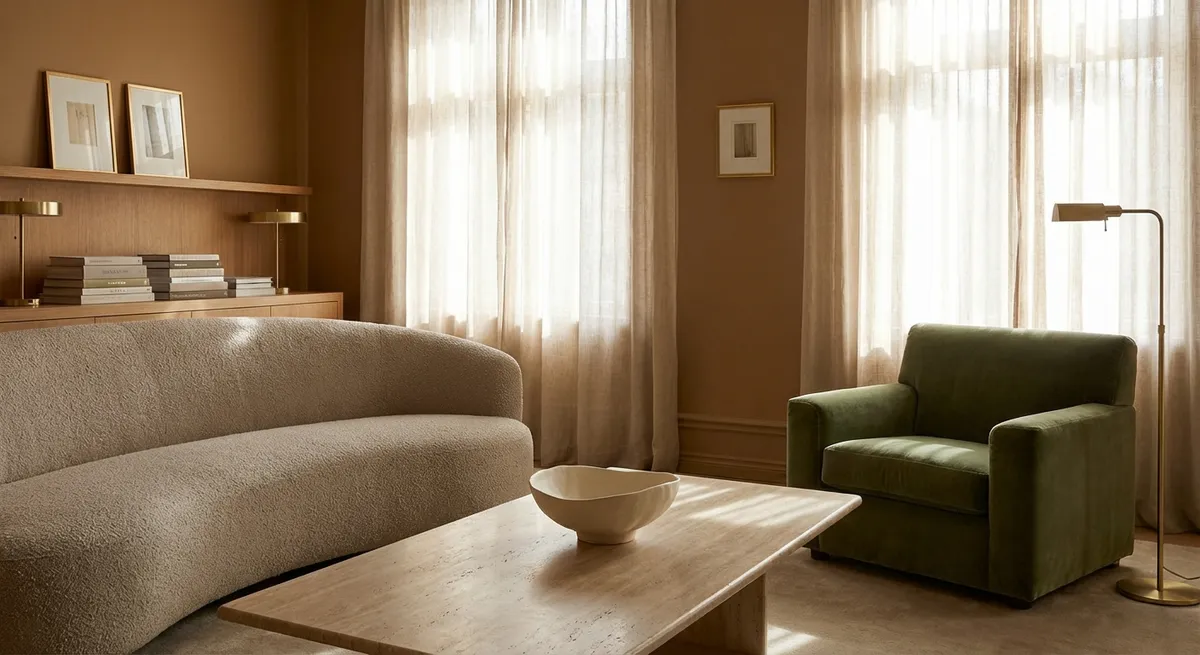
Rather than relying solely on heavy insulation, sophisticated renovations pursue layered solutions: decoupled walls and ceilings, acoustic underlay beneath stone or timber flooring, and solid-core interior doors with carefully detailed thresholds. Even joinery design matters—soft-close hardware, felted cabinet interiors, and integrated buffer strips contribute to a pervasive sense of calm. Materials are selected not only for visual warmth, but for how they absorb, diffuse, or softly reflect sound: wool rugs, upholstered wall panels, textured plasters, and linen drapery build an auditory landscape as much as a visual one. Homeowners who invest in acoustic detailing often report that the home feels “more expensive” in a way that is difficult to articulate but impossible to ignore.
3. The New Naturalism: Material Authenticity with Architectural Discipline
The appetite for “natural” materials has matured beyond mere rusticity into a more exacting, edited vocabulary. The most compelling homes now pair authentic, tactile finishes with controlled lines and disciplined geometry.
Stone is specified with an awareness of origin and veining, used in large, uninterrupted slabs that feel architectural rather than decorative. Timber is celebrated in fewer, higher-quality species, carried consistently from millwork to flooring to furniture to create a quiet continuity. Plaster and limewash finishes introduce a subtle depth that shifts with daylight, while metal accents—patinated brass, aged bronze, blackened steel—are used sparingly as functional punctuation rather than ornament. This new naturalism is not about abundance, but about restraint: fewer materials, used with conviction, detailed precisely at edges, junctions, and transitions. Renovators who embrace this approach find their homes age gracefully, gaining character rather than requiring constant “refreshing.”
4. Ritual-Centric Planning: Spaces Designed Around How You Live, Not Just Where You Sit
Floor plans are evolving from room-based thinking to ritual-based thinking. Instead of asking, “Where is the dining room?” sophisticated homeowners are asking, “Where does dinner actually unfold, from prep to conversation to clean-up—and how should the architecture support that?”
This shift leads to micro-zones designed around specific daily rituals: a concealed breakfast station with pocket doors and integrated power; a dedicated tea or coffee niche with built-in filtration and considered lighting; reading corners aligned with natural light and fitted with integrated charging and shelving; or arrival zones that choreograph keys, coats, parcels, and devices with effortless order. The kitchen is often reimagined as a layered sequence—front-of-house for hosting, back-of-house for serious prep and storage—rather than a single open stage. By mapping daily patterns before drawing walls, homeowners create homes that feel intuitively supportive; every gesture, from making a morning espresso to returning from travel, is anticipated in the design.
5. Future-Resilient Refinement: Designing for Aging, Adaptation, and Long-Term Value
The most sophisticated renovations now quietly plan for decades, not just the next design cycle. This is not about clinical “universal design,” but about embedding flexibility and ease into a refined architectural language.
Subtle level changes are minimized to allow for future accessibility without sacrificing elegance. Showers are designed with linear drains and continuous flooring so that, if needed, a bench or grab support can be introduced later without appearing like a retrofit. Doorways are fractionally widened; circulation is simplified; key spaces (a potential future bedroom, a full bath, a compact laundry) are placed on the main level even in multi-storey homes. Behind the walls, generous conduits and accessible junction points allow for future technology and system upgrades without invasive demolition. Storage is planned with adaptability in mind—modular interiors, adjustable shelving, and multi-depth cabinetry that can be reconfigured as lifestyles change. For homeowners, this future-resilient refinement protects both quality of life and long-term resale value, all while preserving a composed, design-forward aesthetic.
Conclusion
Renovation at a cultivated level is rarely about spectacle; it is about orchestration. Softly integrated technology, acoustic serenity, disciplined natural materials, ritual-centric layouts, and future-resilient planning together form a new vocabulary of luxury—one that privileges experience over excess.
For homeowners, the opportunity lies in treating every decision, visible and invisible, as part of a coherent strategy. When architecture, systems, and daily rituals align, the home ceases to be a collection of rooms and becomes a quietly powerful instrument for living well.
Sources
- Harvard Joint Center for Housing Studies – Improving America’s Housing – Research on renovation trends, homeowner priorities, and long-term housing investments
- U.S. Department of Energy – Energy Saver – Guidance on integrating efficient systems and infrastructure into home design
- American Society of Interior Designers (ASID) – Trends Outlook Report – Industry insights on evolving residential design priorities, including wellness and technology
- International WELL Building Institute – WELL Building Standard – Framework connecting acoustics, materials, and daily rituals to healthier, more supportive environments
- MIT School of Architecture and Planning – Design and Computation – Academic perspective on how technology and design thinking intersect in built environments
Key Takeaway
The most important thing to remember from this article is that this information can change how you think about Design Trends.