Renovation today is less about spectacle and more about discernment. Homeowners are moving beyond trend-chasing and toward interiors that whisper rather than shout—spaces that feel composed, enduring, and quietly intelligent. In this new landscape, design trends are not seasonal fads; they are strategic signals of how the most considered homes are being shaped. Below are five exclusive, nuanced directions emerging among homeowners who treat renovation as an art of long-term curation rather than a one-time project.
1. Layered Natural Palettes: Color as Atmosphere, Not Decoration
The most sophisticated homes are embracing color not as a decorative afterthought but as an architectural tool to sculpt mood and movement. Instead of stark whites and harsh contrasts, we’re seeing layered neutrals infused with subtle undertones—stone greys with green warmth, oatmeal beiges touched with blush, deep browns with a quiet plum depth. The effect is a room that feels calm at first glance yet reveals complexity over time.
This approach allows spaces to transition gracefully from daylight to evening, avoiding the flatness that often comes with a single dominant tone. Homeowners are building palettes the way one might build a wardrobe: anchor hues that feel timeless, supported by a few tonal “accent” colors rather than bold, fleeting statements. Painted millwork, ceiling finishes, and even interior doors are being integrated into the palette, turning surfaces into a coherent visual field rather than isolated elements.
For renovations, this means specifying color early—alongside flooring and stone—not as a late-stage cosmetic decision. A well-orchestrated palette also extends to hardware finishes, switch plates, and ventilation grilles, so no element inadvertently breaks the visual spell. The result is a home that feels less decorated and more composed, like a space that has always existed in this particular harmony.
2. Textural Elevation: Quiet Luxury Through Material Contrast
If color sets the mood, texture delivers the intimacy. The most compelling renovations now use material contrast to create visual richness without relying on ornament. Think brushed limestone against finely honed plaster, open-grain oak adjacent to lacquered cabinetry, and boucle or mohair upholstery beside sleek metal detailing. These contrasts invite touch and create depth under any lighting condition.
Instead of defaulting to a single “hero” material used everywhere, homeowners are curating three to five core textures and repeating them strategically throughout the home. A veined marble that appears in the kitchen reappears as a small detail on a powder room vanity; a custom stain on flooring is echoed in stair handrails and window casings. This repetition, handled with restraint, creates a sense of continuity without feeling monotonous.
Refined interiors are also moving away from overtly shiny finishes toward materials with a softer, lived-in sheen—brushed metals instead of mirror-polished chrome, matte ceramics instead of high-gloss, limewash instead of synthetic sheens. These finishes are more forgiving over time and give the home a sense of quiet permanence. When planning a renovation, it’s worth investing in a material board and viewing samples in changing light over several days. The subtleties revealed in that process often distinguish a merely “nice” renovation from one that feels genuinely elevated.
3. Purposeful Zoning: Spaces That Anticipate How You Actually Live
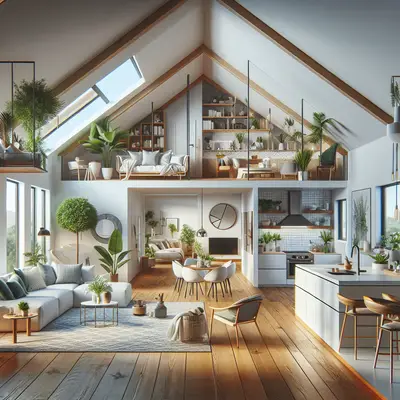
The most intelligent design trend is not a look but a way of thinking about space. Instead of open-plan everything or a rigid series of closed-off rooms, the emerging preference is for subtle zoning—spaces that are visually connected but functionally distinct. Homeowners are asking: Where do conversations naturally happen? Where do we retreat? Where is noise acceptable, and where must it never intrude?
Architectural gestures are becoming more refined: half-height walls that define without enclosing, wide cased openings that frame transitions, ceiling drops and material shifts that signal a different zone without the need for doors. A living area might share a footprint with a dining space, yet a change in ceiling treatment or floor inlay creates a psychological boundary that guides behavior. This is design as choreography.
For renovations, this means mapping actual daily patterns before drawing any walls. A breakfast niche can be created through a built-in banquette and tailored lighting, carving out a cocoon within a larger kitchen. A reading alcove or “quiet corner” can be formed by a partial partition or a change in floor finish. These understated moves create homes that feel intuitively usable and gracious, where every zone has a defined purpose and ambiance—even if there’s no physical door.
4. Integrated Technology: High Performance, Invisibly Resolved
Technology in the sophisticated home is increasingly invisible by design. Rather than walls dominated by large black screens and cluttered wiring, the emerging standard is total integration: TVs disguised within millwork, speakers recessed or fabric-clad, charging infrastructure seamlessly embedded in joinery. The goal is a home that feels analog and tactile at first impression, yet responds effortlessly to modern demands.
Renovation-savvy homeowners are planning for infrastructure at the very beginning: wiring chases, dedicated AV closets, and future-proof conduits that can accommodate tomorrow’s systems without re-opening walls. Lighting controls are being consolidated into minimalist keypads rather than banks of switches, and smart thermostats are chosen as much for their visual discretion as for their features. The most refined builds treat technology as part of the millwork package, not as a separate, last-minute overlay.
There is also a shift toward wellness-oriented tech that disappears into the environment: air filtration systems integrated with HVAC, filtered water at multiple points, circadian lighting schemes that subtly shift color temperature over the day. In a premium renovation, these decisions are not indulgences; they are the quiet underpinnings of comfort and health. The homeowner experiences the effect—better sleep, cleaner air, smoother daily routines—without the visual noise of gadgets everywhere.
5. Curated Flexibility: Rooms Designed to Evolve With Precision
The traditional approach to renovation freezes spaces around current life stages: a playroom that becomes obsolete, a home office that feels awkward once work habits change. The new, more nuanced trend is to imbue spaces with curated flexibility—rooms that can evolve meaningfully without feeling improvised or temporary.
This is not the vague idea of “multi-purpose,” but a far more tailored strategy. A “library” might be designed with concealed power, integrated storage, and sightline-conscious placement so it can function as an elegant office today and a refined sitting room or guest space later. A secondary bedroom might be planned to accommodate a murphy bed within millwork that looks like cabinetry, not a compromise. A generous landing can be detailed as a gallery now and a study nook in the future.
To achieve this, homeowners are investing heavily in the underlying bones: reinforced walls for future shelving, floor outlets positioned where furniture layouts may shift, and neutral yet luxurious finishes that suit several potential uses. Hardware, lighting, and built-ins are selected to feel appropriate across multiple scenarios—never so specialized that the room becomes trapped in a single identity. This level of foresight allows a home to remain relevant and graceful through changing careers, family compositions, and lifestyle preferences.
Conclusion
Today’s most compelling design trends are united by a single principle: they privilege discretion over display. Layered palettes, elevated textures, purposeful zoning, invisible technology, and curated flexibility all point to a new standard in renovation—one in which every decision carries the weight of longevity and quiet pleasure. For homeowners attuned to refinement, the goal is not to create a “show home,” but to orchestrate a private world that feels deeply resolved, endlessly livable, and beautifully future-ready.
Sources
- Harvard Joint Center for Housing Studies – Improving America’s Housing - Research on remodeling trends, homeowner priorities, and long-term renovation patterns
- American Institute of Architects (AIA) Home Design Trends Survey - Insight into emerging residential design directions and homeowner demands
- Architectural Digest – Interior Design Trends - Coverage of high-end interiors and evolving design aesthetics in luxury homes
- US Department of Energy – Energy Efficient Home Design - Guidance on integrating efficient systems and infrastructure during renovation
- MIT School of Architecture + Planning – Research - Broader context on architectural innovation, spatial planning, and built environment strategies
Key Takeaway
The most important thing to remember from this article is that this information can change how you think about Design Trends.