A transformative renovation is less about adding “more” and more about editing with conviction. For discerning homeowners, the true luxury lies in how a space functions, feels, and endures—not in how loudly it announces itself. When a renovation is treated as a process of curation, every choice can serve a purpose: to improve daily rituals, clarify flow, and quietly signal quality through proportion, material, and restraint.
What follows are five exclusive, often-overlooked insights that sophisticated renovators use to move beyond surface upgrades and into the realm of truly elevated, enduring homes.
Designing for Ritual, Not Just Rooms
The most successful renovations are not drawn around furniture plans; they are drawn around the way you actually live. Instead of starting with “kitchen,” “living room,” or “primary suite,” begin with a mapping of your daily rituals—morning, work, entertaining, unwinding, and hosting.
Ask precise questions:
- Where does the first 30 minutes of your day unfold?
- Where do coats, keys, and bags land the moment you step inside?
- How often do you host, and what kind of hosting—intimate dinners or large gatherings?
- Where do you naturally gravitate with a glass of wine, a book, or a laptop?
When you design for these rituals, circulation improves almost automatically. A breakfast zone bathed in early light, a landing space between the entry and the kitchen for parcels and outerwear, or a quiet “perimeter desk” incorporated into millwork can all reshape how your home serves you.
This approach often leads to smaller, more efficient spaces that feel more luxurious because they are so specifically attuned to you. A renovation that begins with ritual yields interiors that feel intuitive, calm, and unmistakably custom—even when the finishes are intentionally understated.
The Power of Spatial Hierarchy: Calm Through Contrast
Luxury is not a constant crescendo—it’s a composition of highs and lows. Spatial hierarchy is the quiet principle that gives a house both ease and drama: some spaces are intentionally expansive and luminous; others are intimate and cocooned. Together, they create rhythm.
Instead of trying to make every room equally “special,” consider:
- A calm, visually restrained entry that opens into a more generous living area.
- Lower, more intimate ceilings in hallways that then reveal a loftier ceiling in the main gathering space.
- A palette of gentler tones in circulation spaces, reserving richer, deeper hues for rooms where you linger, such as a library or dining room.
- Deliberate compression—like a narrower transitional corridor—before a room with a generous opening or larger windows.
By orchestrating these transitions, you create a sense of arrival, not just entry. This hierarchy also helps prioritize investment: allocate premium finishes, bespoke millwork, and custom lighting to rooms with the highest emotional and functional impact, while allowing secondary spaces to support quietly and efficiently.
The result is a home that feels composed rather than crowded with competing focal points—where certain views and moments are elevated, and others recede gracefully.
Material Integrity: Choosing Fewer, Better, and Proven Elements
In an era of endless options, truly sophisticated renovations are defined by disciplined material selection. Instead of chasing the newest finish, they emphasize material integrity—choosing surfaces that age with character, withstand use, and feel satisfying to touch.
Several strategies embody this ethos:
- Commit to a restrained material palette. A limited set of woods, stones, and metals used consistently across rooms produces a cohesive, high-caliber feel. Reducing visual noise often makes even modest spaces feel elevated.
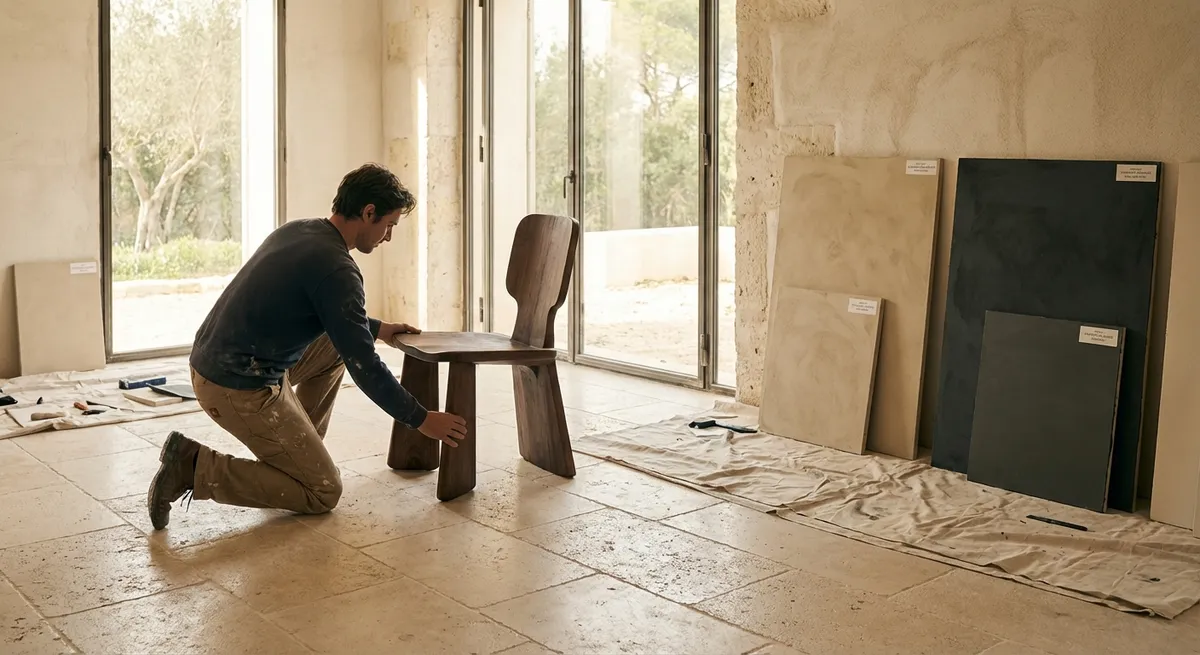
- Prioritize tactile quality over visual novelty. Honed stone, limewash, solid wood, unlacquered brass, and wool textiles all bring a tactile dimension that reads as quietly luxurious, even when the design itself is simple.
- Think in decades, not design cycles. Ask: How does this surface look and perform after 5, 10, or 20 years? Materials that can be refinished, repaired, or patinated gracefully often outclass those that merely look impressive on installation day.
Material integrity is also a sustainability strategy. Durable, repairable finishes reduce the need for premature replacement, aligning beauty with longevity. The home feels calm not only because it looks coherent, but because it is structurally and materially equipped to endure everyday life.
Light as Architecture: Beyond Fixtures and Into Atmosphere
Most renovations treat lighting as a late-stage decorative decision. The most refined projects treat light as a primary architectural element—planned with as much care as layout and structure.
Think in layers and in time, not just in lumens:
- Daylight first. Study where natural light enters, how it moves across the day, and where you experience glare or shadow. You might adjust window sizes, deepen jambs, or add interior glazing to borrow light from brighter rooms.
- Multiple light levels. Combine ambient lighting (recessed or concealed), task lighting (over counters, desks, reading chairs), and accent lighting (washing a textured wall, highlighting art, or grazing stone). This flexibility allows the house to shift from energetic to serene with a few dimmer adjustments.
- Color temperature and consistency. Warm, consistent color temperatures (often in the 2700K–3000K range for residential interiors) support a sense of calm and cohesion. Mixing too many color temperatures can make even beautiful spaces feel disjointed.
- Integrated lighting details. Cove lighting, under-cabinet illumination, step lighting, and recessed strip lighting in niches or shelving add depth without visual clutter from excessive fixtures.
When light is treated as an architectural medium, evenings feel composed rather than simply “lit.” The home supports different moods—focused, convivial, or restful—without relying on harsh overhead sources or decorative fixtures doing all the work.
Strategic Resale Intelligence Without Designing for “Everyone”
Sophisticated homeowners understand that while a renovation should deeply reflect their lives, it is also a meaningful asset. The art lies in protecting long-term value without flattening the home into something generically marketable.
A refined approach to resale intelligence includes:
- Anchoring key spaces to broadly desirable fundamentals. A well-proportioned kitchen with quality cabinetry, efficient workflow, and generous storage tends to hold value even if the finishes are personal. The same is true of updated mechanicals, sound insulation, and thoughtfully configured bathrooms.
- Channeling personality into reversible layers. Color, hardware, wall treatments, and freestanding pieces can all express individuality without locking a future owner into costly changes. Meanwhile, layout, window placement, and core materials remain timeless and adaptable.
- Avoiding overly specific built-ins in secondary spaces. A fully customized room for a singular hobby or use can be polarizing. Opt for flexible millwork—beautifully crafted, but easily reinterpreted as an office, library, guest room, or den.
- Documenting the renovation with clarity. Organized documentation—plans, permits, warranties, and specifications—signals seriousness and care. For future buyers, this is often as persuasive as any visible upgrade.
The goal is not to design for a hypothetical buyer; it is to create a home that feels both distinctly yours and structurally sensible. Renovations that pair aesthetic refinement with technical rigor tend to command respect—and value—over time.
Conclusion
An elevated renovation is less about spectacle and more about precision: in how you choreograph daily rituals, shape spatial hierarchy, select honest materials, orchestrate light, and safeguard long-term value. When approached as curation rather than accumulation, the process becomes quieter, but the results are more resonant.
For homeowners who seek a home that feels composed, enduring, and unmistakably intentional, these principles offer a framework that outlasts trends. Your renovation becomes not just an upgrade, but a considered redefinition of how your home supports a life well-lived.
Sources
- [U.S. Department of Energy – Energy Saver: Daylighting](https://www.energy.gov/energysaver/energy-efficient-lighting/daylighting) - Guidance on optimizing natural light for comfort and efficiency
- [Harvard Graduate School of Design – The House: Reconsidered](https://www.gsd.harvard.edu) (search “housing” and “residential design” resources) - Academic perspectives on residential layout, light, and material use
- [National Association of Realtors – 2022 Remodeling Impact Report](https://www.nar.realtor/research-and-statistics/research-reports/remodeling-impact) - Data on which renovations deliver lasting value and owner satisfaction
- [U.S. General Services Administration – Daylighting and Energy Performance](https://www.gsa.gov/governmentwide-initiatives/sustainability/sustainable-facilities-tool/green-building/strategies/daylighting) - Technical insights on the performance benefits of thoughtful daylight design
- [MIT School of Architecture + Planning – Design Research Publications](https://sap.mit.edu/research) - Research on space, behavior, and design strategies that shape how people live and interact in built environments
Key Takeaway
The most important thing to remember from this article is that this information can change how you think about Home Renovation.