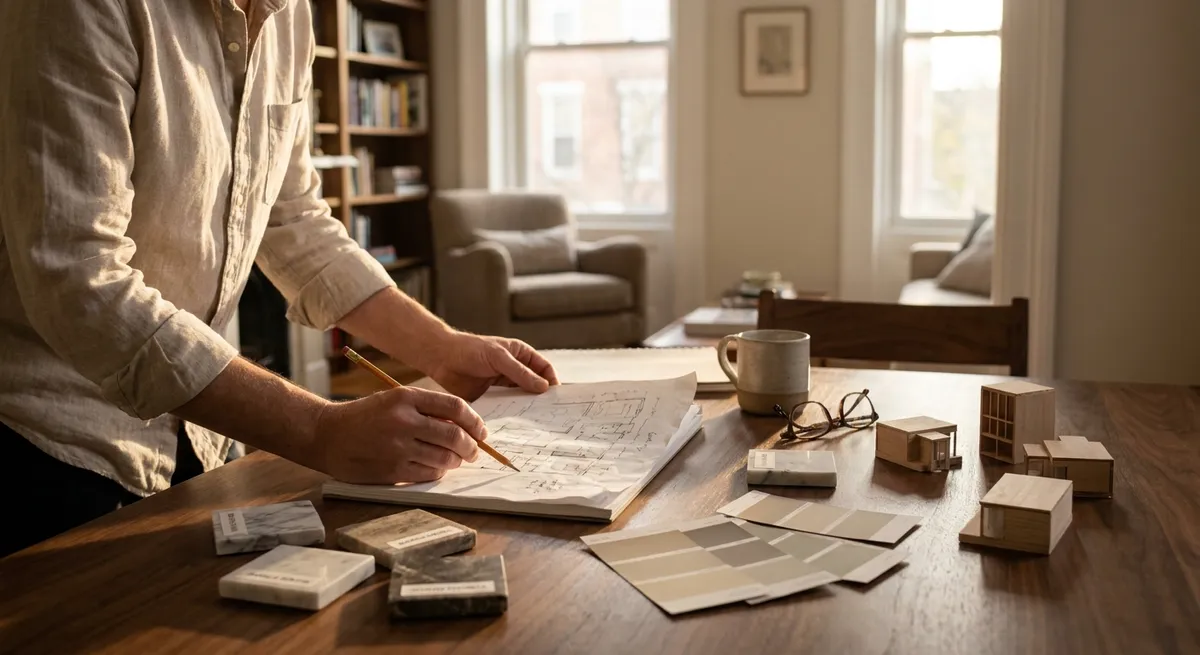
A refined renovation does not begin with a hammer; it begins with a brief. Not a mood board of passing preferences, but a precise, almost literary document that articulates how you intend to live—and what you will not tolerate compromising. For homeowners who expect their spaces to behave as gracefully as they look, project planning becomes less about surviving construction and more about authoring a standard of daily life. The difference between an ordinary project and an exceptional one is rarely a dramatic gesture; it is the cumulative effect of quiet, disciplined decisions made long before demolition begins.
Designing for Behavior, Not Just Aesthetics
Most renovation plans are drafted around what a space will look like; the more sophisticated approach is to plan around how it must behave. Before measuring walls, measure patterns: where you naturally drop your keys; how you like your kitchen to sound at 7 a.m.; whether guests should intuitively know where to hang a coat without asking.
Translate these habits into explicit planning directives. The kitchen island is not just an object; it is a behavior hub—will it carry laptops, cocktails, homework, or all three? A mudroom is not only storage; it is your daily decompression chamber—how do you want that transition from outside world to private realm to feel? When your architect or designer understands that you are designing for rituals, not just finishes, the project brief stops being decorative and becomes operational.
This behavioral lens also mitigates regret. You stop asking, “Will this be beautiful?” and begin asking, “Will this consistently support the way we live?” The former can be achieved with styling; the latter requires disciplined planning and a willingness to interrogate your own routines with unusual honesty.
The Invisible Framework: Planning for Systems You Never Want to Notice
Sophisticated homeowners know that the best-performing renovations are defined by what you almost never see. Project planning at a premium level involves treating mechanical, electrical, and structural decisions as design elements, even when they remain invisible.
Early in planning, insist on a systems brief: how should the home sound, feel, and perform across seasons and decades? Quiet HVAC, consistent water pressure, ample and discreet power, and thoughtful lighting circuitry all demand early coordination. Ductwork paths, plumbing runs, and structural reinforcements must be resolved before ceiling heights, millwork details, or fixture locations are finalized.
This is also where you make strategic decisions about future flexibility. Leave accessible chases for potential solar integration, EV charging, or greywater systems. Specify panel capacity and conduit routing to avoid tearing open finished walls when technology evolves. The most elegant homes are not the ones that resist change; they are the ones tactically prepared for it.
The Calendar as a Design Instrument, Not a Constraint
In most projects, the schedule is treated as a necessary nuisance—a Gantt chart to be tolerated. For the attentive homeowner, time becomes an instrument of quality. When you plan the calendar as deliberately as the floor plan, you protect craftsmanship, reduce costly rework, and avoid the frantic compromises that surface when deadlines are arbitrary and inflexible.
Begin with sequencing logic, not target dates. Which decisions are load-bearing for subsequent trades—structural, waterproofing, and rough-in locations—and which are safely deferrable—textiles, decorative fixtures, accessories? Build deliberate “decision buffers” into the schedule: protected windows for reviewing shop drawings, testing paint samples in shifting light, or walking the site with your designer before millwork is fabricated.
Also consider seasonal intelligence. Exterior work scheduled in the wrong month can sabotage finishes; certain materials cure and acclimate differently depending on temperature and humidity. A sophisticated plan acknowledges that time is not neutral: some weeks are more valuable than others. You are not simply counting days; you are curating conditions under which people can do their best work.
Five Exclusive Insights for the Exceptionally Attentive Renovator
These are planning moves rarely discussed in standard renovation guides, yet they quietly distinguish a merely “nice” project from a deeply intelligent one.
1. Establish a “Non-Negotiables Dossier” Before You Select a Team
Before seeking bids or interviewing professionals, create a concise document outlining your non-negotiables: acoustic expectations, privacy zones, storage standards, thermal comfort thresholds, and your tolerance (or lack thereof) for visible technology. This dossier protects you from being talked out of what actually matters to you once drawings, costs, and compromises enter the conversation. It also helps you instantly identify which professionals are genuinely aligned with your standard of living versus those who are simply selling style.
2. Demand Mockups for Any Detail You Will Touch Daily
Highly used elements—banister profiles, cabinet pulls, faucet operations, step nosings, door hardware, and even light switch placement—should be experienced before they are finalized. Request physical mockups, sample installations, or 1:1 tape layouts on site. A handrail that looks exquisite on paper but feels sharp or awkward becomes a daily irritation. Sophisticated planning assumes that anything you will touch multiple times a day deserves pre-approval in real space, not just on a screen.
3. Pre-Plan “Quiet Zones” in the Budget for Tactile Upgrades
You do not need every surface to be extravagant; you do need a handful of touchpoints to be unmistakably refined. During planning, earmark small, protected budget zones for tactile luxuries—door hardware that feels substantial, a shower valve that operates like a precision instrument, drawer slides and hinges that move with a soft certainty. These are often marginal cost increases with outsized experiential impact. By ring-fencing them early, you avoid watching them get sacrificed when generic value engineering begins.
4. choreograph Utility Access as Deliberately as Storage
Access panels, shutoff valves, cleanouts, and equipment doors are typically treated as afterthoughts, which is why they end up awkwardly placed and visually disruptive. In the planning stage, ask your team to present an “access map” showing where every critical service point will be located—and how it will be concealed or integrated. A panel hidden within millwork or a discreetly placed hatch in a closet preserves the serenity of your finished spaces while ensuring that maintenance can be performed without invasive demolition.
5. Define an “Operational Handover” as a Formal Project Phase
Most homeowners receive keys and maybe a stack of manuals. A truly elevated project includes a formal operational handover: a walkthrough where you learn how to maintain finishes, operate systems, adjust lighting scenes, manage filtration, and troubleshoot common issues. Build this into the project plan from the outset, along with curated documentation: a digital home manual, maintenance calendar, and a prioritized list of whom to call for what. Sophisticated planning acknowledges that your renovation’s success is measured not just on day one, but on day 1,000.
Drawing Boundaries Without Losing Grace
Exceptional planning requires a delicate balance: firm standards without antagonism, curiosity without indecision, and a willingness to delegate without abdicating judgment. The tone you set at the planning stage will echo throughout the project.
Be explicit about communication protocols: how frequently you expect updates, in what format, and which decisions require your input versus those you are comfortable delegating. Ask your team to surface trade-offs clearly—cost versus longevity, speed versus precision, novelty versus proven performance—so you can make decisions aligned with your priorities rather than defaulting to the quickest solution.
Crucially, protect the project from decision fatigue. Identify in advance which categories matter deeply to you and which you are content to leave to your designer’s discretion. Your energy is a finite resource; aim it at the decisions that truly shape how you will live in the space rather than dispersing it across hundreds of inconsequential choices.
When boundaries, expectations, and rituals of decision-making are planned with intention, the project ceases to feel like an adversarial negotiation and becomes a shared pursuit: a collective effort to produce a home that behaves, feels, and endures as you originally imagined.
Conclusion
A renovation that feels inevitable—as if it could not have been designed any other way—is never accidental. It is the product of a rigorous, quietly ambitious planning process that privileges behavior over décor, systems over spectacle, and long-term ease over short-term convenience.
By treating your renovation brief as a serious instrument, orchestrating time as thoughtfully as space, and insisting on refined details where they matter most, you move beyond a project that is merely “done” into one that is deeply composed. The true luxury is not the marble on the countertop; it is the calm knowledge that every visible and invisible decision was made on purpose.
Sources
- [U.S. Department of Energy – Home Renovation & Remodeling](https://www.energy.gov/energysaver/home-improvement-and-repair) – Guidance on planning energy-efficient systems and upgrades that should be integrated early in project planning
- [Harvard Joint Center for Housing Studies – Improving America’s Housing](https://www.jchs.harvard.edu/research/improving-americas-housing) – Research on long-term renovation trends, investment patterns, and homeowner priorities
- [American Institute of Architects – Working with an Architect](https://www.aia.org/resources/69546-working-with-an-architect) – Best practices for defining project goals, briefs, and collaboration protocols with design professionals
- [National Institute of Building Sciences – Whole Building Design Guide](https://www.wbdg.org/design-disciplines/integrated-design) – Insight into integrated design and systems coordination that informs early-stage renovation planning
- [This Old House – Remodel Planning & Budgeting](https://www.thisoldhouse.com/home-finances/21017759/remodeling-survival-guide) – Practical considerations for sequencing, scheduling, and decision-making during residential renovations
Key Takeaway
The most important thing to remember from this article is that this information can change how you think about Project Planning.