Renovation at the highest level is no longer about installing what everyone else has already discovered on social media. It is about orchestrating an environment that feels inevitable in its elegance—spaces that seem as though they could not have been conceived any other way. For homeowners ready to invest with intention, the most compelling design trends are not loud declarations but intelligent, layered decisions that quietly elevate daily life.
The following five insights are not surface-level trends; they are strategic shifts in how discerning homeowners are thinking about space, materiality, and long-term value—choices that position a home to feel relevant, resilient, and deeply personal for years to come.
Insight 1: Architecture-Led Color Instead of Trend-Led Palettes
Sophisticated renovations are moving away from colors chosen solely for fashion and toward palettes dictated by architecture, orientation, and light. The most successful schemes now begin with questions that are almost architectural in nature: How does the sun move through this room? What materials are adjacent? Which surfaces should visually recede, and which should advance?
Rather than defaulting to an “accent wall,” a more elevated approach is to let structural elements determine a hierarchy of tones. Load-bearing columns, deep window reveals, and ceiling coffers can be subtly emphasized with nuanced shifts in color value, creating depth without visual noise. North-facing rooms, for example, may call for warmer neutrals to compensate for cooler light, while south-facing spaces can tolerate cooler, more complex shades without feeling austere.
This architecture-led color strategy also works beautifully with natural materials. When stone, timber, and plaster establish the baseline, paint becomes a supporting player rather than the main event. The result is a home in which color feels inevitable—rooted in the bones of the house rather than layered on as an afterthought. Over time, this approach tends to age gracefully, precisely because it responds to immutable conditions (light, proportion, volume) rather than fleeting fashion.
Insight 2: The Return of Tactility as a Quiet Marker of Luxury
In considered renovations, touch is becoming as important as sight. The most refined homes now orchestrate a textural gradient—from the cool solidity of stone beneath bare feet to the softened grip of a leathered handrail or the almost imperceptible texture of a limewashed wall. These choices are subtle, but they profoundly shape how a space is experienced.
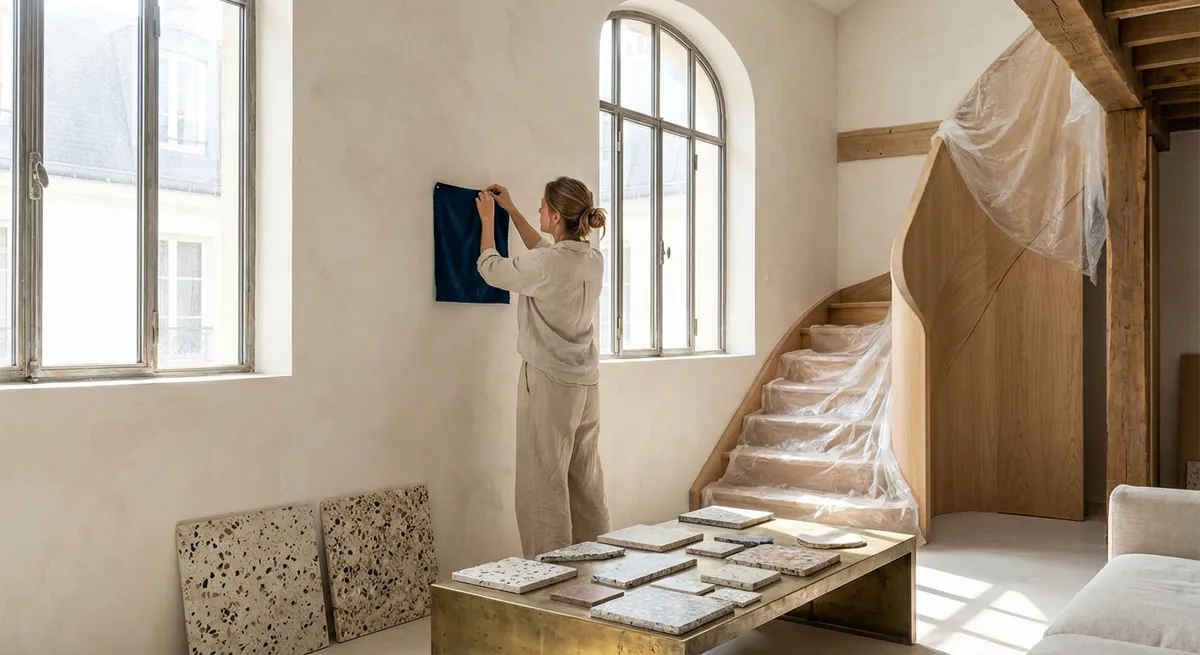
Visual minimalism is increasingly paired with tactile richness: honed stone rather than polished, unlacquered brass that develops a patina rather than high-shine chrome, and fabrics with a quiet hand—bouclé, wool, linen—rather than loud patterns. Textured wall finishes, such as microcement or Venetian plaster, add depth without adding visual clutter, catching the light in ways paint simply cannot.
For homeowners planning a renovation, the strategic move is to identify “high-contact” zones: stair rails, door pulls, countertops, the interior of drawer fronts, the underside of hand-height edges. Investing in tactile excellence in these areas yields an outsized sense of quality, even if the overall palette is restrained. It communicates a kind of quiet confidence: the luxury is not broadcast; it is discovered in the details your hand meets every day.
Insight 3: Layered Light as a Spatial Strategy, Not a Decorative Afterthought
Lighting is undergoing a structural revaluation. In elevated renovations, it is no longer treated as a late-stage decorative choice but as a primary tool for defining zones, rhythms, and moods. The most sophisticated homes now treat light almost like architecture—sculpting how spaces are read and inhabited from morning to night.
Rather than relying on a grid of recessed downlights, refined schemes layer multiple sources: concealed cove lighting to soften ceiling planes, integrated LED within millwork to halo shelving, highly directional task lighting at preparation zones, and carefully dimmable decorative fixtures that punctuate key sightlines. The goal is not brightness; the goal is nuance.
The emerging strategy for homeowners is to design for multiple “light compositions” per room. A kitchen, for example, might have a bright, evenly lit configuration for cooking, a softer perimeter glow for evening conversation, and a near-ambient level for late-night circulation. This degree of intentionality requires planning early in the renovation process—long before fixtures are specified. The payoff is a home that can shift moods with precision, supporting both daily routines and elevated entertaining without feeling staged.
Insight 4: Precision Zoning for Realistic, High-Function Living
In the most thoughtfully renovated homes, open-plan excess is quietly giving way to calibrated zoning. The focus is no longer on sheer openness but on connection with control—spaces that relate to one another yet allow for different activities to coexist without visual or acoustic conflict.
Designers are achieving this through a series of finely tuned moves: partial-height partitions that preserve sightlines while absorbing sound; pocket doors with acoustic seals for flexible privacy; changes in floor material or ceiling height that subtly delineate one zone from another. Kitchens are being planned with “front-of-house” and “back-of-house” logic—beautifully detailed islands and social zones paired with rigorously organized, more concealed prep and storage areas.
For homeowners, the strategic advantage is longevity. Families and lifestyles change; a home with intelligent zoning can adapt without major restructuring. A generous hallway with integrated millwork can later double as a homework area or a compact home office. A slightly over-scaled landing can become a reading niche or quiet lounge. By thinking in terms of “spatial roles” rather than rigid room labels, renovations gain a long-term flexibility that feels both luxurious and practical.
Insight 5: Technology That Vanishes into the Background
The most elevated renovations are no longer about showcasing technology but about making it disappear. Screens retreat into millwork, speakers dissolve into ceilings, and climate control integrates quietly into architectural elements rather than calling attention to itself. The aesthetic objective is calm; the experiential objective is extraordinary performance with minimal visual evidence.
This does not mean less technology—it means more discerning integration. Robust wired infrastructure is concealed in walls and ceilings to support evolving smart systems over time. Lighting scenes, shading, and climate are orchestrated through discrete keypads rather than a proliferation of visible hardware. Even in kitchens, induction cooktops that read as seamless planes of counter, integrated refrigeration, and concealed downdraft ventilation are replacing the visual clutter of traditional appliances.
For homeowners planning a renovation, the key is to think of technology as a layer of infrastructure rather than a collection of gadgets. Investing in concealed pathways, access panels, and service zones during construction allows for upgrades without disruption. In practice, this yields a home that feels timeless to the eye, yet is quietly equipped to handle new standards of comfort, efficiency, and security as they emerge—future-ready without appearing “high-tech.”
Conclusion
The most compelling design trends for cultivated renovations are not driven by novelty—they are grounded in refinement. Architecture-led color, tactile richness, layered light, precision zoning, and invisible technology all share a common thread: they privilege lived experience over spectacle. For homeowners ready to renovate with intentionality, these currents offer a framework for decisions that will feel relevant and resonant well beyond the current moment.
When every detail is filtered through the lens of longevity, quiet function, and sensory quality, a renovation stops being a project and becomes a legacy. The result is a home that does more than look current on a screen; it feels profoundly right in person, day after day, year after year.
Sources
- [Harvard Joint Center for Housing Studies – Remodeling Futures Program](https://www.jchs.harvard.edu/research-areas/remodeling) - Research insights on renovation trends, homeowner behavior, and long-term investment patterns in residential remodeling
- [American Institute of Architects (AIA) – Home Design Trends Survey](https://www.aia.org/resources/6312949-home-design-trends-survey) - Professional survey data on emerging patterns in residential design, including layout, technology, and material use
- [U.S. Department of Energy – Energy Saver: Lighting Choices](https://www.energy.gov/energysaver/lighting-choices-save-you-money) - Guidance on layered lighting strategies, efficiency considerations, and technical underpinnings relevant to integrated lighting design
- [Gensler Research Institute – Residential Design Perspectives](https://www.gensler.com/research-insight) - Industry-grade analysis on how people use space, including insights on zoning, open-plan evolution, and functional layouts
- [MIT School of Architecture + Planning – Design and Computation Resources](https://sap.mit.edu/research/design-computation) - Context on how technology and infrastructure are being woven discreetly into built environments for future-ready homes
Key Takeaway
The most important thing to remember from this article is that this information can change how you think about Design Trends.